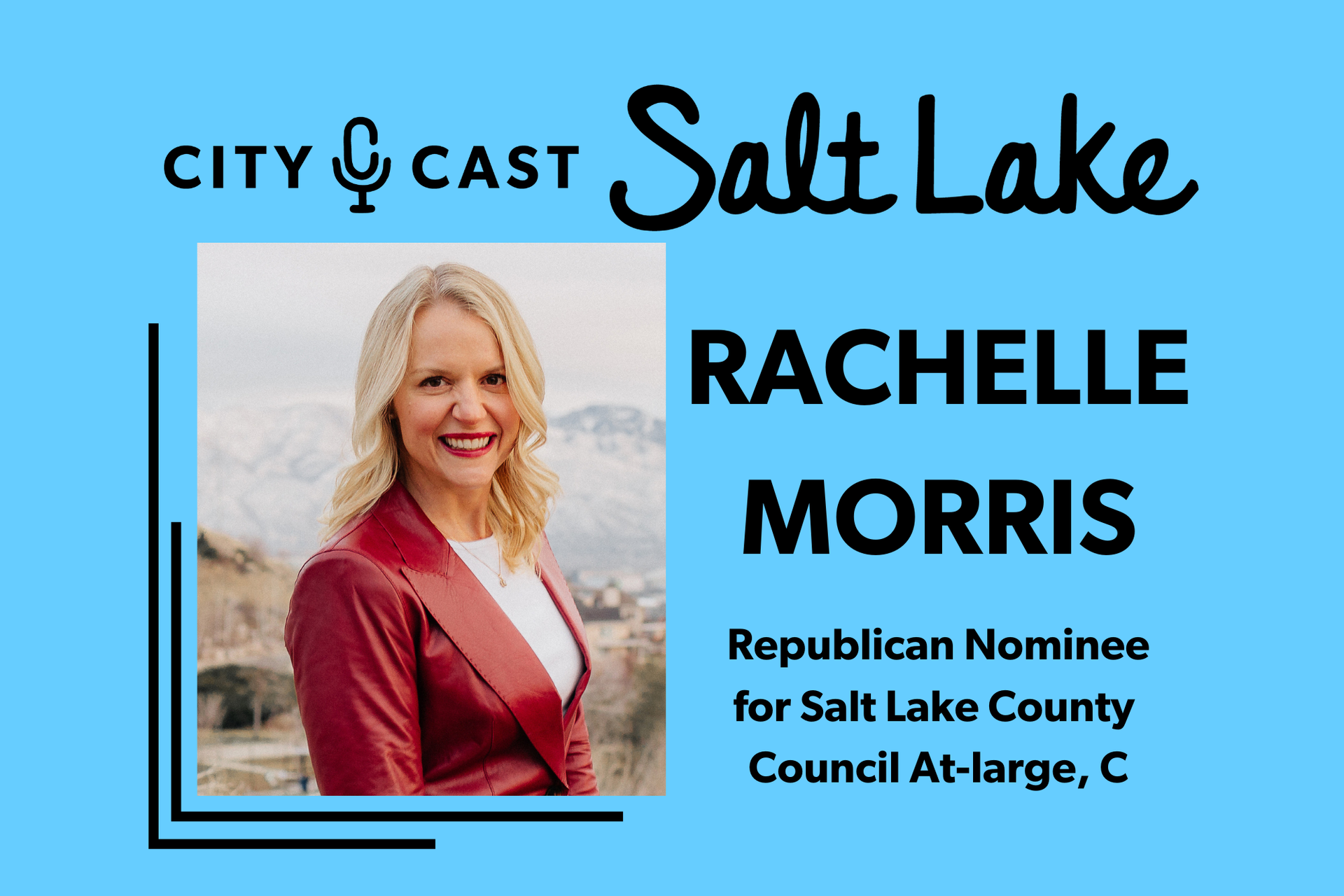
The race is on for an open, at-large seat on the Salt Lake County Council! Host Ali Vallarta asks Republican candidate Rachelle Morris how she would approach this big role in homelessness, affordable housing, and criminal justice. Tomorrow, you’ll hear from her opponent, Democratic candidate Natalie Pinkney.
Scroll down to read the transcript of our interview with Rachelle Morris.
Learn more about Salt Lake County’s new homelessness plan.
Photo: Rachelle Morris
Become a member of City Cast Salt Lake today! It’s the best way to support our work and help make sure we’re around for years to come. Get all the details and sign up at membership.citycast.fm.
Subscribe to our daily morning newsletter. You can also find us on Instagram @CityCastSLC.
Looking to advertise on City Cast Salt Lake? Check out our options for podcast and newsletter ads.
Learn more about the sponsors of this episode:
- Zoo, Arts, and Parks Reauthorization and Preservation Committee
- The Shop
- Babbel - Get up to 60% off at Babbel.com/CITYCAST
- Vote.utah.gov
- Nightmare on 13th
TRANSCRIPT
Ali Vallarta: Today on City Cast Salt Lake: Salt Lake County is home to one third of Utah's population. One third. And the Salt Lake County Council plays a big role in some of our most pressing issues – homelessness, affordable housing, and criminal justice. Now the race is on for an open seat on that county council representing all 1.2 million of us. And today, we're finding out what the Republican candidate, Rachelle Morris, has planned. A quick disclosure here, Rachelle's opponent in this race, Democrat Natalie Pinkney, and I have been friends for years. Trust that the City Cast Salt Lake team approached our conversations with each candidate based on their records, their websites, and the issues Salt Lakers care most about.
Rachelle Morris – Republican candidate for Salt Lake County Council – as an at-large candidate, you are running to represent 1.2 million people in this county, and that is even more than our congresspeople represent in their districts. When you think about moving the needle on one thing for all those residents, what is it?
Rachelle Morris: I know John Curtis and I were actually having this conversation about a week ago because he realized, wait a second, a countywide race in Salt Lake County is about one and a half times the size of a congressional race. And I go, that is correct, Congressman. And you know, just one of those like mind-blown moments.
So when I think of serving all 1.2 million people who call Salt Lake County home I have the same constituents as the county mayor does with a six year term, right? And so I think about how the structures of government inform the roles and maybe job descriptions of the people who occupy those seats.
So the county mayor, chief executive officer of the Salt Lake County government, right? The county council is the legislative branch of the county government and oversee the purse strings of the budget that the county mayor proposes. The at-large seats, I feel like are kind of like a miniature Senate where it is our responsibility. Because we have six year terms, we represent the entire county, and it is our responsibility to understand what is going on inside of all of the cities across the county and the pockets of unincorporated county that still exist, and then take it up to a 50,000 foot level and say, ‘Okay. This is a stewardship seat. I understand what's going on in Magna. I understand what's going on in Sandy and up in Alta and in Salt Lake City, which is where I live. Now, coalesce all these things together. Obviously, the district representatives on the council are going to be fighting and advocating for the parts of the county that they geographically represent. But I need to always operate with a stewardship lens and my background and career is actually in financial services and asset and wealth management and now venture capital where I invest in early-stage software companies and electric vehicle companies. I have a track record of successfully managing and stewarding other people's money. I view the 1.2 million people who live in Salt Lake County as the investors of Salt Lake County's growth, development, and trajectory. And my job is to steward the hard-earned taxpayer money that everyone pays into the county government and to think how can we make the county government's operations stretch these dollars further and work better for all of our investors? Who are all of our taxpayers who call Salt Lake County home?’
Ali Vallarta: So am I hearing you correctly then, that your one issue is financial stewardship?
Rachelle Morris: That is my biggest issue, yes, is thinking through how do we manage the county budget in a way that's wise; in a way that optimizes performance at a county government level. And look, you know, as I've been meeting with residents all across the county they feel that. They want to feel like they have a financial advocate on the council. And so when you look at all of the talents and skills of this nine-person council, I mean, we have stellar people on our county council. Amy Winder Newton's been on for 10 years, right? And she now serves in the governor's cabinet – the Office of Families – for the state of Utah.
We have, you know, Suzanne Harrison, who's an anesthesiologist, and she brings her skill set of being a doctor to the council. Many talents and skills, right? But no one who's currently serving on the council comes from a background of finance and investment. And so, I just, I know I will bring value by bringing that investor lens and framework to county council conversations when we talk about managing taxpayer money.
Ali Vallarta: I'm not surprised to hear you say that. Because it is the top issue listed on your campaign website, financial responsibility. And you said you want to, and this is a quote, “prioritize responsible budgeting and work to eliminate government waste.” But the county budget is nearly, yes, two billion dollars. It's already pretty tight, though.
It was just recently that the mayor implemented a hiring freeze because of it. So you make a great point, the county council controls the purse strings. What services or resources do you think we could do without?
Rachelle Morris: Yeah, and I'm not, how do I put this, I'm not campaigning in a the-county-government-is-a-disaster kind of campaign.
And anyone who's been following knows that. But I've also met with several people who work inside the county government and who share their perspectives and experiences of working for the county. And, you know, every single department across the county, this is just one example, right? And I'm not saying that this is the first thing that I'm going to go after, but this is just an example that I think any listener could say, ‘Oh, that's interesting.’
There is not necessarily, like a central comms department for the county government. And so what happens is every department then has a comms team inside of the departments. Well, if this were a private sector corporation, there would be a centralization of a comms department to then represent the different departments that make up that private corporation.
That would be something that I think where we could gain some efficiency. Another thing is, you know, I invest in early stage software companies and electric vehicle companies. There are new technologies that are coming out – AI, blockchain – you think of a core county function is tied to our real estate and surveying properties, understanding property rights and property lines across the county, which I think should be at the regional government level, and then recording property real estate transactions. Well, are there opportunities to implement new technologies to make these functions work better?
Ali Vallarta: You have me Googling blockchain for like the tenth time this year, Rachelle. What is the blockchain?
Rachelle Morris: Oh man, it's a decentralized ledger. Now we're really nerding out, but it's a decentralized ledger that operates in real time. And once something is recorded, leveraging blockchain technology, there is no amending it.
Ali Vallarta: Got it.
Rachelle Morris: There's a lot of exciting, innovating things that are happening in technology. How do we incorporate that into the county government? I'm not necessarily saying that Salt Lake County needs to be the beta test for all county governments across the country, but could we, as a county of 1.2 million people, you know, try to be in the top quartile of, ‘All right, well, Fulton County in Atlanta is doing this. Or this county, you know, over in Texas is doing that. And it looks like it's getting traction in its first 18 months. Oh, Rachelle, you have a widespread network in our tech community, in our Silicon Slopes community, can we start, you know, sharpening our pencils and figuring out if we can incorporate this inside Salt Lake County?’
I want to have a very collaborative relationship with all the departments in the county, you know, wearing the hat that I wear.
Ali Vallarta: I hear you saying to the answer to my question of like how to make a budget tighter that it sounds like you're interested more in like how the county government is organized, departments, things like that, less than tinkering with the budget and like parks and recs and like day-to-day services. Is that fair?
Rachelle Morris: I'm not a subject matter expert in how our parks division should be run. And to campaign with a mantra that the parks department should decrease by half a million dollars annually when I have never even served in elected office, like, that would just be so naive and arrogant of me to do that.
Ali Vallarta: Well, Salt Lake County is one of the fastest growing counties in the state. It's no secret. And we're experiencing about half a million more residents by 2060, which is pretty mind-blowing. If elected, what types of policies or budget asks would you support to help plan for growth?
Rachelle Morris: Yeah, and again, I think this is where being an at-large member is really critical for me to think, what is the job description here, being in a six year term? And you know, I'm running to be Jim Bradley's successor. Jim Bradley's the only human who has ever held the seat. He has held the seat for 24 years, and prior to that, he was a county commissioner. I am not necessarily planning on trying to match or beat Jim Bradley's record of how many years of service, but it is at least one six year term. And so, alright. There are several levels of government here. We have our municipal. We have school boards, right? We have the county. We have the state. And we have federal.
As an at-large representative of Salt Lake County, I believe that it is incumbent on me to have good working relationships with city council members and city mayors across the county, right? To be able to collaborate with municipal governments, and then also to have good working relationships with state leaders, with our governor, with the senate president, speaker of the house, members of the legislature – especially the members of the legislature who represent part of Salt Lake County. But also with members of the legislature who don't live in Salt Lake County and sometimes feel an us-versus-them of, ‘Well, we live in Washington County, you know, and that darn Salt Lake County gets blah, blah, blah, blah, right?’
Like, I want to be able to call that representative or grab dinner during the session, right? And have this ongoing dialogue to be able to talk through Salt Lake County specific issues, right? To be able to peel that onion with them and to get understanding and commonality rather than tribalism between different counties inside the state legislature. I think that's really important. And then to also have good working relationships with our federal representatives, you know, our U. S. senators, our congressional delegation. And so you create that framework. And I promise I'm answering your question because it's so often that it's federal money or state money that then is allocated to the counties for infrastructure development and we need that infrastructure investment in Salt Lake County over the coming years to be able to get the water tanks that need to be built, the roads that need to be built, so that then the neighborhoods can get developed so we can build more housing, so that then we can meet the demands of growth.
Ali Vallarta: I hear you saying relationships matter in getting infrastructure projects done in Salt Lake County. Are there specific policies that you're interested in, that plan for growth?
Rachelle Morris: I think what the governor has proposed and his housing Czar, that's really intriguing to me, where you're leveraging some of the state's reserves. And I mean, we're not talking about using a major portion of the reserves, but you know, it's still hundreds of millions of dollars that could be tapped for credit that then is an offset to the cost of borrowing capital that real estate developers would need in order to start putting shovels in the ground to build the houses that need to be built in Salt Lake County. So that is something that's very interesting to me.
I believe strongly in, you know, you want more affordable housing. Well, we need to increase the supply of housing. But also having spent time – a lot of time in the Southwest quadrant of the county this year – if you're living in Salt Lake City and you haven't been out to Riverton, to Mountain View Village, or Herriman, like, go on a weekend and go check out the Southwest quadrant. I think you'll be blown away by the amount of development and growth that's going on in that part of the county. You drive down the road and you can tell the difference between a development that's a row of townhouses that was built to be rentals and the long term sustainability and viability of that neighborhood, versus a community like Daybreak that has been master-planned, that has trails and parks and waterways and a well-designed downtown and Mayor Dawn Ramsey and her city council are crushing it, right? And I know several people who live in Daybreak, who have intentionally chosen to raise their family in Daybreak because of the way that it was designed.
I want new neighborhoods in Salt Lake County to be thoughtfully designed and developed in a way where, yes, people can move there as their starter home. But what if they end up just deciding to live there for 20, 30, 40 years? Like, that is where then we will have neighborhoods that are safe, that have low crime rates, and that have a unity and community feeling for many, many years. And that is a savings to our county government budget over the long haul, for sure.
Ali Vallarta: It's funny you bring up Riverton because we talked to Riverton Mayor Trent Staggs on this show a couple weeks ago, and he said, in his view, it's not the city's responsibility or a city's responsibility to be building housing. But I hear you say you're interested in making sure that housing projects, that the right kind of housing projects, are getting greenlit. So what do you think the county's role is in making that happen?
Rachelle Morris: The county's role potentially here from my perspective – and I'm sure people have different perspectives than mine – we are not an additional regulatory agency on cities, right? But the county does own a lot of real estate and we do have a county parks and rec department, right, county library system? So how does the county come in and be a regional player as the new development is happening? And like I know, for example, with our equestrian center
Ali Vallarta: RIP.
Rachelle Morris: RIP. But hey, I went to the 4-H auction day there and it's in much better condition and everyone who is involved with that land swap deal with the Butterfield Canyon trails, right?
Every single person says, ‘Well, we were nervous and skeptical going into it, but it's actually worked out well.’ And it's one of the projects that Mayor Ramsey talked about, where South Jordan had to swap some land with the county, and then a private family came in as well, and it's worked out well, but it requires creative problem solving there on behalf of multiple players. That's where you have to have that collaborative relationship across levels of government because, you know, someone who lives on the very western, southwest flank of West Jordan is a constituent of Mayor Dirk Burton. Also a constituent of the county government, also a constituent of their state senator, their state house rep, the governor, you know, their member of congress, right?
And so, you know, we as a team across levels of government serve the same people. And staying in your lane, I guess, is maybe what I'm trying to say more succinctly. Stay in your lane, you know, but be very collaborative and know your lane well enough that you can think in innovative and creative ways because you know the guidelines, the restrictions, the frameworks to operate inside of.
Ali Vallarta: Maybe bend your lane, don't break your lane.
Rachelle Morris: Yeah, or, you know, lock arms with a city mayor who's really being brave and courageous, right? And who maybe needs some help lobbying at the state level. Alright, let's go, Mayor Burton. Let's go, Mayor Palmer. Let's go, Mayor Staggs. Like, you and I, we've agreed that this is a good idea to happen inside of your city, inside of Salt Lake County, and Salt Lake County does, you know, have a role inside of this because it might involve some of the property that we own, you know, or some of the services that we provide via a rec center, library. Alright, let's go arm in arm up to the state. Let's get this thing accomplished for your city.
Ali Vallarta: We of course can't separate housing and homelessness. On your website's list of issues, you highlight homelessness under the umbrella of public safety. I thought that was interesting. If elected, you'll have a seat at the table with the many, many stakeholders on this issue: the state, the cities, service providers, philanthropists who are already guiding policy decisions around homelessness. What would you propose differently?
Rachelle Morris: Golly, you know, we have, if you're listening to this podcast and you live in Salt Lake County, you will be voting on a public safety bond to the tune of $507 million dollars.
Ali Vallarta: That's right.
Rachelle Morris: And that sticker price always comes with shock to people of, 'Wait, how much money for the jail?'
I kind of want to talk through a couple things here. And number one, county jail is the largest budget line item in the county government. Public safety, the number one role of the county government from my perspective. And it's the highest line item, not where the vast majority goes, but it's the highest line item.
We have not added a county jail bed in 24 years. Meanwhile, and so as long as Jim Bradley has been on the county council, we have not added another jail bed. Just to put it in context when people say, ‘Wow, Jim is still in office.’ I love the man. We've had a great time getting to know each other this year. So our population has grown, right? I think it makes sense to expand the jail so that then we can increase the amount of beds that are here to serve our greater population.
You talk to any law enforcement agency across the county. That is definitely a point of frustration is that our jails are pretty much at max capacity. We have a jail dashboard on the county government website. So if you want to nerd out, you're welcome to go check out the dashboard. I actually, I recently toured the county jail for a couple of hours with the other county council candidates who are running for office this year.
And Chief Dumont talked about how 25 percent of the inmates at our jail are currently homeless. And that is a big percentage. And not only that, but there are, and I know this when I... Well, first of all, I live in Salt Lake City, so I'm acquainted with this issue inside of our capital city, but also I've done candidate meet and greets downtown and downtown residents are just tired of cars being broken in and things that I would call more or less crimes of homelessness, where people are desperate. They need to get access to cash or something as quickly as possible. They're addicted to drugs. And it's awful. And this is just a cycle that has only been getting worse.
It has not been getting better. Although I'm excited by the fact that the state, the county, the city are all working together now to move the needle on homelessness. The county jail is the largest mental health facility of the state of Utah as well. This is just a really expensive way to manage the issue of homelessness in our county.
What interests me even more is that inside this public safety bond, there is a justice and accountability center.
Ali Vallarta: Right.
Rachelle Morris: That's earmarked a hundred million dollar budget for this. This will be a step-down corrections facility that I would say the inmates who are being arrested and processed for crimes of homelessness who maybe need to have an elevated level of security for a brief period of time to be able to get clean and sober and to get job skills to then be autonomous, crime-free, drug-free individuals in our community. I'm very interested in working with county leaders and with state leaders and Mayor Mendenhall and Salt Lake City leaders and law enforcement agencies to make sure that this justice and accountability center does its intended purpose and we move the needle on homelessness.
I love organizations like the Other Side Academy – that approach, and the Other Side Village, that are approaching this idea of, it is more humane to say, we believe that yes, you are a convicted felon, or yes, you have been living on the streets for years. We believe that three years from now, you can be completely self-autonomous.
You can be crime-free, drug-free, living a healthy, happy, productive life. And anytime – have you been to the Other Side Academy?
Ali Vallarta: Yeah, I have.
Rachelle Morris: Yeah. Meeting with the students of TOSA, golly, I ... It's inspiring and it's humbling every time I have an opportunity to spend time at the Other Side Academy.
Ali Vallarta: I get this impression from your website, reading your website, that you think that Salt Lake County has not prioritized the criminal justice reform element of solutions to homelessness enough, and yet so much of Salt Lake County's new five year homelessness plan and so much of this $507 million bond you meant you bring up is related to the jail and criminal justice reform.
So what do you think then is missing? Like what on that note do you want to see that isn't in play here?
Rachelle Morris: Well, I've spent a lot of time in the Rose Park, Fair Park neighborhoods of Salt Lake County this year, and the Jordan River Trail. In these sections of our county, they are open-air drug markets.
You talk to law enforcement and they say, ‘Yeah, guess what? I could arrest people for this drug deal that I literally just saw and I will take them to the jail and then they will be back right there within a couple of hours.’ And then the residents of Rose Park and Fair Park say, ‘Well, we can't even go along the Jordan River Trail. We can't even go, you know, to the neighborhood park. And my kids can't use the bathrooms at the neighborhood park anymore because there's literally needles on the floor.’
I am not saying this as Rachelle Morris, candidate, ‘Oh, let's get some explosive talking points.’ I'm literally, Ali, relaying things that residents of Rose Park, Fair Park, of our Westside have communicated to me while I've been spending time in their communities this year.
That's where, you know, building out more capacity to fit the needs of our community inside of our corrections facilities and, you know, the Justice and Accountability Center, that is going to be a lower level corrections facility. You know, it, this is about making sure that families across the county feel like they have safe access to the parks and trails inside of their communities, regardless of what part of the county they live in.
Ali Vallarta: Rachelle, you're a Salt Lake resident, which means that this fall, in addition to your own name being on your ballot, the bond will be on your ballot. It's $507 million dollars, includes expanding the jail, building an alternative to jail. How do you think you're going to vote on that?
Rachelle Morris: Well, I will be voting for the bond.
Ali Vallarta: Okay, got it. Let's talk about the politics of Salt Lake County. You mentioned that you've been all over the place. Right now there's a slim Republican majority on the Salt Lake County Council. Salt Lake County is one of three counties in the state that has been a reliable Democratic stronghold, though registered Republicans do outnumber Democrats.
How would you make sure that residents across the political spectrum are represented in your decision making on the Council?
Rachelle Morris: First of all, I have friends of all political persuasions. And so, and I'm really proud of that. I'm really proud of being a Republican woman who lives right next to the whale in Salt Lake City.
There's about 50,000 registered Republicans in Salt Lake City. And so my team and I, we like to joke that there are dozens of Republicans who live in Salt Lake, but there's actually more than that. My private sector work, I have worked with individuals of all political persuasions. I do not screen people who I collaborate with based on their politics, right?
And I am a partner at a fund with many Utah investors who also represent the political spectrum – Republican, Democrat, Independent, more Libertarian, more progressive, right? I know how to collaborate well with people who see the world differently than I do. And I have intentionally, you know, knocked on doors of thousands of Salt Lake County residents all across the county.
We even have a spreadsheet tracker because yes, I am a nerd, to make sure that I'm spending time in every city across the county and tracking it. and that's like my little mechanism to make sure, ‘Hey, well, it's been two weeks since you've been to Cottonwood Heights. Oh, I need to get to Cottonwood Heights. I need to prioritize that this week.’ And so I love this county and Ali, forgive me, but I'm going to tell a story.
So this last Saturday morning, I started my day at a Great Salt Lake coastal cleanup project that Friends of Great Salt Lake organized and, you know, picked up a whole bag of trash over the course of an hour, hour and a half. My team, we were knocking doors in Magna, which is technically where I was on the coastal cleanup project. So I go and join my team. I'm knocking doors in Magna. The seventh door I knock on is a man whose name is Kenneth on my app. And so I go, ‘Are you Kenneth?’ And he goes, ‘No.’ And I go, ‘Alright, Kenny?’ You know, and he goes, ‘'m John. Who are you?’ And I go, ‘Well, I'm Rachelle Morris. I'm running to be Jim Bradley's successor on the Salt Lake County Council. And I'm knocking doors in your neighborhood, getting to know, you know, people in the Magna community today and wanting to hear what's top of mind for you.’ He goes, ‘Rachelle, I have lived 73 years in Magna, minus my college football days at SUU. My entire life, and never once has a county-wide candidate ever knocked on my door. How do I know that you give a *** about me and about the City of Magna?” And I go, ‘Well, I'm happy to have a conversation with you about, you know, what I've learned and have you fill in the gaps for me.’ And before you know it, we spent an hour together. And it was just this incredible conversation. I learned so much about the history of Magna and halfway through he goes, ‘Oh, you actually do care about our city.’ And I go, ‘Well, there's tons of kids who live in Magna. There's tons of opportunity for growth over the next many years. And also I know about the public health risks and things that Magna deals with by being right next to the Great Salt Lake. And I really want to be connected to the Magna community so that I can represent you well.’ I live in – you know, the next thing that I went and did is I went to the Avenue Street Fair. Could not be more different. It took less than 25 minutes to go from John's house to the Avenue Street Fair. And had a great time at the Avenue Street Fair meeting entrepreneurs who've gone all in on building their small businesses. I believe entrepreneurship is the backbone of growth in our country.
And I believe that Salt Lake County is a great place for entrepreneurs to live. I want to continue to foster that kind of environment over the next many years. And so, long story long, I'm here to collaborate and work with anyone who wants to make Salt Lake County the best metropolitan area in the Western United States. And quite frankly, I don't care what letter is next to your name. Let's go. Let's work together.
Ali Vallarta: Well you bring up campaigning in and of itself and of course, one of the most iconic parts of election season is the campaign song. This is a podcast, Rachelle, we love audio. So I want to ask you to pick a campaign theme song.
Rachelle Morris: Well, my walkout song for my county convention speech was Beyonce's "Texas Hold'em." And so I'm a descendant of Utah pioneers, but I did grow up in Houston and I met Beyonce's sister Solange in high school. And so I just love that opening line of, "This ain't Texas. We ain't Hold'em." And I just think, yep, I have decided that I am all in on living in Salt Lake City, in Salt Lake County.
I moved back to Utah six years ago. I'd spent six years here prior going to college and working for Goldman Sachs early in my career in Salt Lake. And this ain't Texas. This ain't hold'em. This is Salt Lake County. Let's go make this the best metropolitan area in the western United States over the next six years.
Ali Vallarta: Rachelle Morris, Republican candidate for Salt Lake County Council At-Large C. Thank you so much for your time.
Rachelle Morris: Thanks Ali.
Ali Vallarta: That is all for us today here on City Cast Salt Lake. We will be back tomorrow morning to hear from Rachelle's opponent, Democratic candidate Natalie Pinkney, on the same issues.