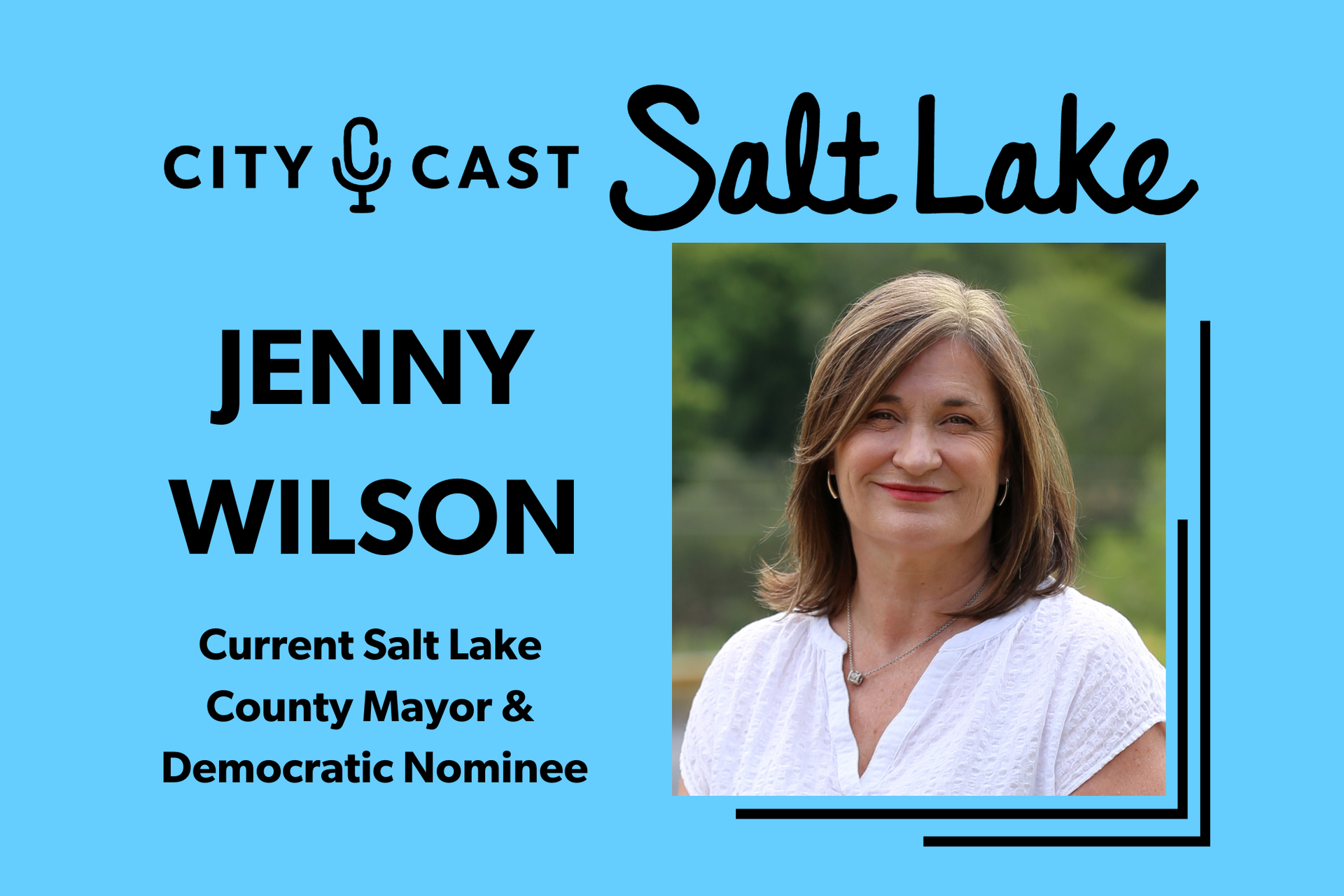
The race is on for Salt Lake County mayor! Even though they represent a third of Utah’s population, we’d bet you don’t think about how the job impacts your life. Host Ali Vallarta talked to Democratic candidate and incumbent mayor Jenny Wilson about her approach to homelessness, affordable housing, and Abravanel Hall. Tomorrow, you’ll hear from her opponent, Republican candidate Erin Rider.
Scroll down to read the transcript of our interview with Mayor Wilson.
Learn more about Salt Lake County’s new homelessness plan.
Photo: Jenny Wilson
Consider becoming a founding member of City Cast Salt Lake today! It’s the best way to support our work and help make sure we’re around for years to come. Get all the details and sign up at membership.citycast.fm.
Subscribe to our daily morning newsletter. You can also find us on Instagram @CityCastSLC.
Looking to advertise on City Cast Salt Lake? Check out our options for podcast and newsletter ads.
Learn more about the sponsors of this episode:
TRANSCRIPT
Ali Vallarta:
Today on City Cast Salt Lake: There is a very good chance you live in Salt Lake County. It is home to one third of the state's population and it has its own mayor and council. People with quite a bit of power making big decisions from homelessness to the future of Abravanel Hall. And the race for mayor of Salt Lake County will be on your ballot, which is being mailed to you in just a few weeks.
So who wants the job? This is the first in a two interview series with candidates Erin Rider and Jenny Wilson. First up, Mayor Jenny Wilson, current mayor, running for a second term as the Democratic candidate. I need to give you a quick disclosure here. In a previous job, I worked for Jenny Wilson. It was 2018.
But trust that we have approached our conversations with each candidate based on their records, their websites, and the issues Salt Lakers care about most.
Ali Vallarta:
Jenny Wilson, Democratic candidate and current Salt Lake County mayor. This county is home to more than a third of the state's population, 1.2 million people. It's a lot of lives that you can impact in this role. When you think about moving the needle on one thing, what is it?
Jenny Wilson: Oh, there can never be one thing in this job.
That's the hard thing. I'll tell you the thing that's taking up the most time, the most attention, and the thing I'm actually most proud of right now – but with so much work to go – is the intersection between criminal justice reform, homelessness, housing, and our jail. And I rolled out a plan. I had a lot of help from our district attorney, our sheriff, incredible staff that works for me under human services, housing.
We came together, we broke down barriers, we published a plan, and I'm really excited about it. We're actually moving a bond proposal to the public, which I never want to ask people to voluntarily have their taxes raised. But if there was ever a time and a need, it's now. So I am asking people to support that.
And it's part of this comprehensive plan. And so that's the biggie right now. But at Salt Lake County, it's our parks, it's our rec centers, it's our trails, it's arts, culture, preserving our canyon. I continue to be concerned about the gondola. There just – there are so many balls in the air, it's hard to narrow it down.
Ali Vallarta: Yeah. Let's talk about the bond, though. Part of Salt Lake County's new homelessness plan includes expanding the jail and building an alternative to jail. Voters will decide if they want to pay for that through a $507 million bond on the ballot this year. Why do you think expanding the criminal justice system will help solve the humanitarian crisis of homelessness?
Jenny Wilson: I think it's important to note that the jail ask and the creation of more capacity is only one aspect of the plan. The broader plan includes a thousand units of deeply affordable housing. We have a housing crisis generally in this county, and we're addressing that. We've got a lot of things that the county is doing for the general housing crisis.
But what I'm talking about when I refer to the thousand units is deeply affordable, with wraparound services and that's a key component. We need more support to people who, even when the capacity in our community is expanded, choose to live on the streets and aren't committing crimes because being homelessness should not be a crime.
So, more support to our health and mental health specialists who support them on the streets, expand those team members. One of the key elements of the plan, our peer specialists who stay with the person throughout their challenges just to help them get on the right path. We're very sensitive, of course, to people's privacy and their choice, but I think a lot of people would like to have somebody with them as they are working to find that stable housing, the job, and move to success.
So the bond proposal is part of a larger plan.
Ali Vallarta: Right. But the housing's not in the bond, right? Like the bond is part of the plan, but the housing is not in the bond.
Jenny Wilson: That's correct. So the housing we're building with partners. We're identifying resources at Salt Lake County. We have a fund that I'm hoping to replenish to continue to kind of chip away.
And we alone at Salt Lake County cannot build those thousand units. It's a partnership beyond, including with the state, and municipal governments. But the bond proposal itself is an element of the plan. And what we realized as we did our gap analysis and looked at the holes in the system is that we've had incredible population growth since the last investment in the jail.
The jail has also fallen apart. We're 40 years in, Oxbow and the main facility, and we have operational challenges of operating two jails. It's expensive, it's not efficient. So, as we looked at throwing more money into jails that are aging, it really was an opportunity for us to change the way we do business in the jail.
So the investment in the capital is really, really key, but with it comes reform. So, what we're looking at is selling our smaller facility, our Oxbow facility, moving those beds over to our main facility, expanding and creating more beds for people in mental health crisis within our jail, and then creating a step down unit of about 100 beds so that as people get closer to their release date, they move to a separate section in the jail. And in that section, they're getting a lot of support for their exit out.
So we're no longer just dumping people on the streets of South Salt Lake. And then the most important element of this plan, I believe, is what we're calling our Justice and Accountability Center. And we plan for 300 beds there. And the idea being that if a police officer or a community member or even a family member has someone in need, this center is an option. And you might have people that are justice involved and you might not, but if people are truly – it's generally meant for low level offenders, but the idea is that the thousand units that I started off talking about, if you find somebody that really is a victim on the streets, we put them straight into housing if they're willing to go and they want to go and they're on that path.
But if there is– if there, are minor offenses, this is a better alternative than a hardened jail cell and a quick release and more challenge for that person to unpack their court cases and move on towards the next phase of a productive life. So, that's the general plan for the bond. As you mentioned, $507 million ask to the taxpayers, for the average household, median household, that's less than $5 a month, under $60 bucks a year. And I think it's [an] investment that's worth making for the public.
Ali Vallarta: Yeah. We covered this plan, this five year homelessness plan, when it was announced on this show, and I think it was really welcomed by a lot of Salt Lakers because in Salt Lake City there's this feeling that we carry the burden, a lot of the pressure within the county for homelessness, and I know it is where a lot of the resources are.
But I want to know – because the plan is new, it's 2024, you've been mayor since 2019, what are some ways that you think that the county and that you have shown leadership on homelessness since 2019 before this plan was announced?
Jenny Wilson: Well, it's interesting. I had the advantage of being mayor for a year and starting to digest the challenge. But additionally, I was complimented by Republican leadership at the legislature, thanked by mayors, and thanked by our business community for picking up the Resource Center debt we took it on as Salt Lake County as a loan to the system when the Resource Centers were built.
Ali Vallarta: Just to clarify, by Resource Centers, you mean the three new homeless resource centers in Salt Lake County that opened after the Road Home closed downtown.
Jenny Wilson: There was a pretty sizable debt and Salt Lake County was the bridge loan to get that paid off to get the resource centers open.
So that was the first thing, was just to better understand the challenges. But I was mayor in those early days of our resource centers opening. I remember one of the first events I went to was actually one of the openings. So we were watching with the providers and working with them to determine a better – I mean, the goal of those resource centers was that they would be better than the downtown facility, which was a mixed use and we hadn't separated out families, women, children, etc.
So, rolling that out was starting to work, even though, rewind time, had I had some say in the choice, I think we didn't build enough beds at the time. But in any event, COVID hit. So all of a sudden you had different operations at the resource centers, you had a lot going on. And so Salt Lake County is really good at working with the providers and pivoting to do the best we could.
And looking back on COVID, would I do things differently? Perhaps. But I'm also very proud of the quick investment the county made in so many different systems. I'm also really proud of the effort that we made to give people factual information on the evolving health crisis through our health department.
Ali Vallarta: Homelessness and housing go hand in hand, of course, and another part of Salt Lake County's homelessness plan that you brought up is developing these 1,000 housing units over the next five years. Now, just – I think it was last week on this show, we talked to Riverton Mayor Trent Staggs, and he told us he doesn't think it's the government's job to help house people.
And that, of course, is interesting given how much growth is happening in the south part of Salt Lake County. As county mayor, what do you think your role is in addressing our affordable housing crisis?
Jenny Wilson: Well, I – it's not the first time I'll disagree with the mayor of Riverton, but that's a really narrow viewpoint because it's clear our free market system is not addressing the problem.
We're also in a state where we're not, we're not going to implement rent control. I mean, if you look at housing policy, the county has a critical role. But actually land use policies and density issues, those are all driven by our localities. And the authority is residing within our cities, towns, etc.
Ali Vallarta: Well, and cities can't implement rent control in Utah, right?
The legislature forbids that.
Jenny Wilson: Yeah, even if you if a mayor wanted to, we don't have – so I think it absolutely is the duty of the county and our cities to do the best that they can do. Cities have a tool and that is their zoning policies and they can figure out land use policies, they can implement density, they can all the while be sensitive to preservation of community around those choices, they can seek federal funds.
What the county can do is be best practices from a regional perspective. And we're doing that. Like, one thing I'm incredibly proud of is that we have put an incredible amount of money into development projects to fund the gap, and to roll out new units. So with that investment, we're seeing more and more product come out online and that should drive down costs and, you know, create a place for people to be.
We were also really key during the era where we were allowed through the federal government and there was revenue to implement programs that kept people from being evicted. And then the feds lifted that at some point.
We actually facilitated, as a county, state money because we were good at supporting people who were unfortunately in a position to rely on some eviction support for a while. So there's a lot of things a county can do depending on the issue from a regional perspective, but land use policies are city oriented and then the state, of course, is the mother of all decisions in this space.
We spent a lot of time advocating and pushing the legislature on better policies.
Ali Vallarta: Are these 1,000 units through the homelessness plan all the units that we should expect from the county over the next five years? Or is there a separate housing approach?
Jenny Wilson: Yeah, there's a separate housing approach and we have a regional development team who's working on housing access, housing availability, and the policy side, primarily.
Ali Vallarta: Is there a unit number that they're working towards, or?
Jenny Wilson: Well, you know, you hear different measurements of the gap in our county, but it's thousands and thousands of units. So really an important role of a county mayor is to coordinate with our cities and work city by city to develop plans and to implement.
And I have a role, I'm lucky enough to serve on the Wasatch Front Regional Council, where not only are they, in this era, focused on transportation funding, but also town center development, working towards development policies that should be embraced by all. And it's a role where we are not only working towards the development of more units, but also really leaning into that policy change that's necessary to achieve the regional goals.
Ali Vallarta: I mean how do you do that? Because one of the big roles of the county mayor is to convene the mayors of all the 23 cities in Salt Lake County. How do you get that kind of housing growth done when you've got mayors at the table, like Mayor Trent Staggs, who don't think it's their city's responsibility to invest in affordable housing?
Jenny Wilson: Well, unfortunately, the county mayor doesn't have any authority over a city's mayor's decisions. So it's convening. It's facilitating federal grants. I mean, that's one of the things the county offers is where, we are a community development block grant. We are the home base for several of the cities, not all.
Salt Lake City has their own CDBG. We have housing support grants that are federal that run down and then run through us. We have a robust grant process to actually roll out that stock. But a lot of – it's influence, education. We hold conferences like ‘The Missing Middle.’ That's a big challenge right now.
I mean, we do see a lot of apartment growth in Salt Lake City right now, which is a great thing. But we're not seeing as many town homes built largely because developers don't find that as you know, the return on that as high.
Ali Vallarta: You mean like condos?
Jenny Wilson: Yeah, condos, town homes, anything other than your typical, you know, multi-level traditional apartment building. So, you know, two-bedroom apartment isn't gonna work for a family of four kids, right?
And that missing. We call it the missing middle. So we work through a lot of the issues in the system that are barriers to the goal that we're all working towards.
Ali Vallarta: Let's talk about growth because the growth anticipated for this county is kind of mind blowing. Right now, looking at a little over a million people in Salt Lake County. But Kem C. Garner Institute anticipates a little under 2 million people by 2060. And the thing about growth is that it can lead to budget pressures. So I know, recently Salt Lake County was passing a less than sexy budget in response to sort of the end of some COVID-19 money from the federal government.
Your campaign website boasts that you cut your office's budgets by 14% in your first year as mayor. But, how do you ensure that we can meet all of our budget needs as we grow?
Jenny Wilson: Well, your tax base should expand with that growth. I mean, the more people you have, the more you know, if you have a strong economy, the more jobs, the more success.
The problem is, we are a county that is incredibly diversified, and that is why we're doing better than many coming out of COVID. But we have people that continue to be left behind. So I think one of the things that's important to me and that I've learned over the years, having worked for Salt Lake County, is that the county really can have an impact on supporting people who are just struggling due to the challenge of the right now, it's — cost of living is very high. We talked a lot about housing, but we've taken active measures to support people who are really just trying to make it right now. And some of the things seem little and then end up being a really big deal, one of them is we launched free recreation passes for kids this year, 60,000 kids signed up.
And I just, even yesterday, asked for a memo on whether or not we need to do anything differently, because that was, a big, exciting experiment and we – I keep hearing from parents everywhere I go that they love it and the kids are active and they're out and they're going to those rec centers and they're able to bring their friends and we're going to assess it and make sure that it's working well and I believe that it is but it's again that investment in affordable housing, free libraries, expanding our libraries, trail development we've built hundreds of miles of trails since I've been mayor.
The biggest and most exciting are recently open near Herriman in our, some of our unincorporated land. We cut a deal with the BLM, the Bureau of Land Management, worked with Kennecott Rio Tinto, and we have now a multi use trail system that didn't exist a year, year plus ago.
And trailheads being developed, urban trails. We connected the west side of the valley to the east over to the Jordan River which had, you know, there have been gaps over the years, we connected. And now you can move all the way from the Bonneville Shoreline Trail over to the Jordan River Trail. And I think that matters because of our, health, back to growth, you know, the three big new regional parks in our area for populations that you know, are spread out throughout.
So everybody has relatively easy access to a regional park now. Those intentional things, our senior centers and making sure as you talk about growth, we're going to have an aging population. So, are we being – our senior program through our centers is keeping people from being isolated in their homes, Meals On Wheels and everything in between.
So I really believe that the heart of our county is just these incredible programs that we're providing so that people are — have a great quality of life here. I believe we do, and I believe that we have to work hard to stay on top of it with the growth demands.
Ali Vallarta: But these programs don't sound cheap.
Like I hear you saying, we have budget needs, we have to keep the budget balanced, it's like you talked about with the last budget cycle, kind of tightening the belt a little bit, and yet like, all of these things that you're naming, these are incredible assets in the county, but they sound expensive, like it's expensive to run a rec center or a Abravanel Hall.
So, is a tax increase inevitable? Because you didn't propose one this year.
Jenny Wilson: Yeah, so ,the one, and we're getting a little into the weeds on tax policy, but one of the challenges is the state doesn't give counties the ability to capture inflation every year. You have to go through this process called “truth in taxation.”
So what the county does is every four to eight years, whatever the number is, raises taxes. And then every year, the fund balance goes down a little more, a little more, a little more, a little more because inflation, I mean, it's been incredibly high. It's stabilized to a certain degree, but it's not going to go down to pre-COVID levels.
So every time we pay employees 3%, 4 % more, we're having to pull from the last tax increase balance. So it's inevitable that there'll be a tax increase in Salt Lake County. I don't know exactly when. We weren't – we didn't need to do it this year. The federal money during COVID was incredibly helpful to us for one time new programs and I'm excited about many of the things we were able to roll out. Some remain and will remain into the future, but we are ultimately in a position to need to enhance our revenues, and it's just a reality.
And I think it's interesting because most county council candidates or mayoral candidates will come in and say, wait a minute, you know, I'm not going to raise taxes, and it's just not possible unless you cut programs. And we always look at that. Is there a program that isn't working? Is there a program that's outdated?
But, I'll tell ya, I think we're pretty good at what we do. And the public values it. And you brought up earlier, a lot of people don't really always understand what the county does. And that's a challenge for us because, again, we're 700 square miles, 23 municipalities. And people are busy in their daily lives, so educating people is really important.
But what I care most about is not so much that people know that that rec center is run by the county, but they know that rec center is there and now they can take their kids there for free.
Ali Vallarta: I think I'm just having trouble understanding how we pay for all of this if we, like, currently have this good, diversified, humming economy at the county level.
We, though, are still operating on kind of a shoestring budget, there's all this growth coming and there's all these plans to increase access to these resources. Like how, for how long could you put off a tax increase?
Jenny Wilson: That I don't know. I mean, we were able to make it through this year and the 2025 budget year without a tax increase.
I mean, I am proposing the bond increase because we don't have the revenue to fund a, you know, 500 – it's actually $605 million proposal, $506 million being asked to be absorbed by the public. So that's an example where major initiatives need to have new revenue. So we are advocating to the legislature, we're working with them to try and fund certain programs.
We're very reliant on federal grants and we're good at applying. We're doing more than ever. I think we have quite a few more. I don't want to name a stat, but it's a very high number beyond years prior of the number of grants we've submitted, because there are a lot of grants available that this federal government is providing through the agencies, through the Biden administration.
So we're working on those grants, prioritizing them, everything from grants that support sustainability programs to justice reform. I mean part of the broader plan is it's a visionary plan and it's an expensive one and we're looking at a five year trajectory and we are going to be relying on some federal grants to be able to meet that plan.
And we're a big government. I mean we with pass- through dollars we're almost a billion dollar government annually. Some of that money is passed through immediately. But we have dedicated funds for certain things. Arts, culture, parks, recreation. That's awesome. The public is asked to support the ZAP Tax this year.
They usually say yes, and I believe they will again. And that is what allows us, the revenue stream, to, to build new rec centers. And as we build new, we have to shift more to maintenance and operations as opposed to, you know, new. But we're now in I think our third cycle of building rec centers and running them.
And that's been an amazing benefit to the community since the zoo arts and parks tax was first envisioned.
Ali Vallarta: Yeah. We should clarify that ZAP tax you referred to as zoo arts and parks, and it funds probably any nonprofit, you know, has at some point seen some ZAP money.
On the note of arts, many Salt Lakers are very worried about the future of Abravanel Hall. That's of course the concert hall where the Utah Symphony plays, it's in downtown Salt Lake City and it's in the middle of the Smith Entertainment Group's future sports and entertainment district downtown. How will you work with the Smith Entertainment Group to protect this taxpayer funded venue?
Jenny Wilson: Well, good question. And I think that question probably leads to a little bit of a discussion around the goals and the plans around the Sports Entertainment Culture and Convention District. So, the big goal for me
Ali Vallarta: Which really rolls off the tongue.
Jenny Wilson: Yeah. The SECC. Another acronym in government. But the goal, my primary goal, is not to lose The Jazz, and hockey from downtown. I think it would be a horrible thing to have the arenas move to a suburban area. And it would be Sandy. I don't think, nothing against Sandy, but I think that we've seen the pulse of the community supported by having the Jazz downtown and now this opportunity for hockey.
And whether or not you love hockey or you go to a Jazz game you have to invest in your downtowns to keep people wanting to live there and to, we want to live and show the banner that our Visit Salt Lake sells, you know, a vibrant community, arts, culture, and everything in between. So, Mayor Mendenhall and I both when we first heard of the opportunity to bring in hockey and the idea of developing this area, were most interested in working with Smith Entertainment so we don't lose The Jazz. And then hockey is an additive, I think.
So, with that arenas now need, whether we like it or not, they're relying on entertainment districts. So, early in the process, I looked at this idea of a vibrant entertainment district, additional days at a remodeled arena, additional game nights, and our, what we do at Salt Lake County, which is arts, culture, and convention.
And our convention industry does really well, but our Salt Palace is aging. So there was an aligned goal, talking to Ryan Smith and his team, about the idea of renovating the Salt Palace, supercharging it, getting some more a ballroom. There's some area we can lose. But in doing that, we have a substantial renovation and we got to pay for it.
We don't yet have that figured out. We've got to work with the state, work further with the city, and continue to work with the Smith Entertainment Group to get that funded. If that doesn't get funded, the county's going to be out. And I hate to say it, but this deal ain't going to happen. So with that, we, one of the reasons I haven't been holding a press conference every other week on any Abravanel Hall developments or what have you is there just aren't any.
So I think that that's frustrating to people who want an immediate answer on what happens to the hall. But the reality is until we get a plan for Salt Palace renovation and how the area is sort of configured in a better master plan. I've heard the analogy, we have crooked teeth downtown and we need to put the braces on.
The crooked teeth are our assets. You can leave, you can be somebody, a tourist who just enjoyed some time at Temple Square. You had, you would have no idea walking out of the corner of Temple Square, where the arena is. There aren't a lot of restaurants in that area. You've got the the Japanese churches, which are amazing assets, but nobody knows where they are unless you're a regular churchgoer.
So, I think that the idea is like, the back of the Salt Palace I, it's not so great, let's just be honest. So, how can we refresh that area, activate the assets, keep The Jazz, add hockey, and all the while So I think fundamentally the question on the hall is and I made a statement some time ago and I'm living it and I believe it and I'm working hard.
I want to preserve the hall in its current form, meaning keeping it as is. The challenge is it blocks access and that visionary, you know, the idea of, you know, correcting the teeth and activating assets is limited by the way that it's built. So I'm trying to figure out is there a way to renovate Salt Palace and create some open walkway around it.
And that's the goal right now. It's easiest for us at Salt Lake County to deal with our own land, but we're talking to other private property owners to see if we can acquire it. And a lot of this is stuff that is, has to be approached from the perspective of the property owners and that's the hat I'm wearing in that position as to how do we negotiate and get this and make it work financially.
Land exchanges, transactions, multiple parties. And that's really what I tell people, and I'll continue to share, is that I think we have to get through a lege session, and when the legislature comes to the table and agrees to support the Salt Palace, everybody benefits: restaurants, hotels, the State, arts and culture, because our bed tax actually feeds arts and culture, back to your question about budget. So we will benefit from this investment, it's just a big one, and it's one that happens fast, and it's one we have to pay for, and the Abravanel decision will happen after that piece gets solved first.
Ali Vallarta: Okay, so if I understand correctly, because from where we sit in Salt Lake City, we're staring down the barrel of this, you know, half a percent sales tax increase to help fund the development of this district, including the renovation of the Salt Palace, as I understand it. There's a participation agreement that basically says if Ryan Smith decides to take The Jazz and go down to Sandy to South Town Shops, they have to pay us back. Are-- am I understanding correctly that there's still on the table, okay, but how do we pay for this renovation to Abravanel Hall? Could that lead to more cost for the county or for taxpayers?
Like, where does that money come from?
Jenny Wilson: Yeah, it will need to be taxpayer funded money, either through the state or through the county or another arrangement with Salt Lake City. So I think that's been one of the things that's been really hard. This is a very complex deal. And I don't, I mean, I think there, the public is rightly frustrated at times.
I mean, I've been from the county perspective, working on our piece. I'm not, I wasn't negotiating the amount of funding that SEG would get in this deal. I don't know the right number. I wasn't asked through the legislation to impose a 0.5 sales tax. My piece is like, how do we have Salt Lake County assets fit into this?
Salt Palace and Abravanel Hall and UMOCA. And then of course I like many want to make sure that we preserve Japantown. And I think they have a great advantage if this happens, there's some really cool upside. to some really cool upside for them, that's my hope. And I -- they've gotten people's attention, as has the symphony, and the symphony lovers, and people who love the hall.
Ali Vallarta: I think I just had this sense that, like, the notion that The Jazz at this point would still leave downtown had been settled by how much they're being offered by Salt Lake City and by the state and by the county, like how friendly it seems that everyone has been to them and what they're asking for.
To be clear, that's still a threat?
Jenny Wilson: There's still a negotiation on getting the full package funded. Because if you think about it from the county perspective. We, nobody would want or say, hey, let's take a bulldozer to the Salt Palace and not replace that square footage. To get the three block visionary plan realized that benefits, you know, the Smith Entertainment Group that really completes out this sports entertainment culture and convention, To get that — to realize each of those points is going to take an overhaul of three blocks, and we're at the heart of it, so we can't come to the table and agree until we have an identified revenue stream. We do have revenue for our Salt Palace, and it just isn't at the scale that we're going to need to do it this quickly.
So yeah, there are a lot of complex conversations going on. That has to be settled before Abravanel's future is determined, whether it's a rebuild or a remodel. And I am working to, to have it be a remodel. It's, I mean, there are a lot of things that are challenges with it, and the cost is similar. I think many will claim it's not, but we've seen the analysis and, It's like your house.
If you're going to remodel your house, the bill's going to go up. It's not an inexpensive proposition. And then if we are to remodel Abravanel Hall, I want it to work for the future, not, I mean, if you're going through a house remodel, you don't want to just fix your air conditioning. You want to have some new tile in your kitchen, right?
You want to have something improved. And I really want to think about the next 50 years. The hall's been there for 40 some odd years. What will the next 50 years mean to the symphony? And we need to focus on that as well.
Ali Vallarta: And I think a lot of people would say as much as The Jazz are an asset to Salt Lakers, so is the symphony.
Jenny Wilson: Absolutely.
Ali Vallarta: On the note of music, I want to close by asking you something related to campaigning in and of itself. So the campaign song is a very iconic part of election season. Of course, this is a podcast. We love audio. Mayor Jenny Wilson. If you had to pick a campaign song, what's it gonna be?
Jenny Wilson: Oh my gosh. I am so disconnected from pop culture, although I do kind of, I'm gonna admit it, I like Taylor Swift and I'm a Chiefs fan. Gosh, help me out. I have no idea. I mean, I don't want to sound cheesy and it sounds too Trumpy, but like “Onlly in America,” Right? I don't know which country singer sings that, because I'm actually one of these people that likes country music, and I think it's unfortunate
Ali Vallarta: I think it's Brooks and Dunn.
Jenny Wilson: Is it Brooks and Dunn? But like, only in this county, only in America. Like, this is an amazing place that we live in, and we have so much opportunity here. And I just left Arthur Brooks, who, and, whose book, I just did a Mayor's Book Club "Love Your Enemies." And he really talks about the division in our politics today, and one neighbor to the next, and how we need to work together and come together.
And so yeah, I think I am inspired by this community. I love what I do. I hope that I will return for four more years because it's a job that I love. And it's really because I'm inspired by our opportunity here, by our challenges and really by the people. So I'll say “Only in America.” Brooks and Dunn.
Ali Vallarta: Jenny Wilson, Democratic candidate for Salt Lake County mayor and current mayor. Thank you for your time.
Jenny Wilson: Thank you.
Ali Vallarta: Tomorrow morning on this podcast you’ll meet Mayor Wilson’s opponent, Republican candidate Erin Rider. And if, at the end of these two interviews, you still want more? There will be a mayoral debate. Thursday, October 3 at 6 p.m. It’s moderated by KUER’s Sean Higgins. Stream it on pbsutah.org and KUER.org.