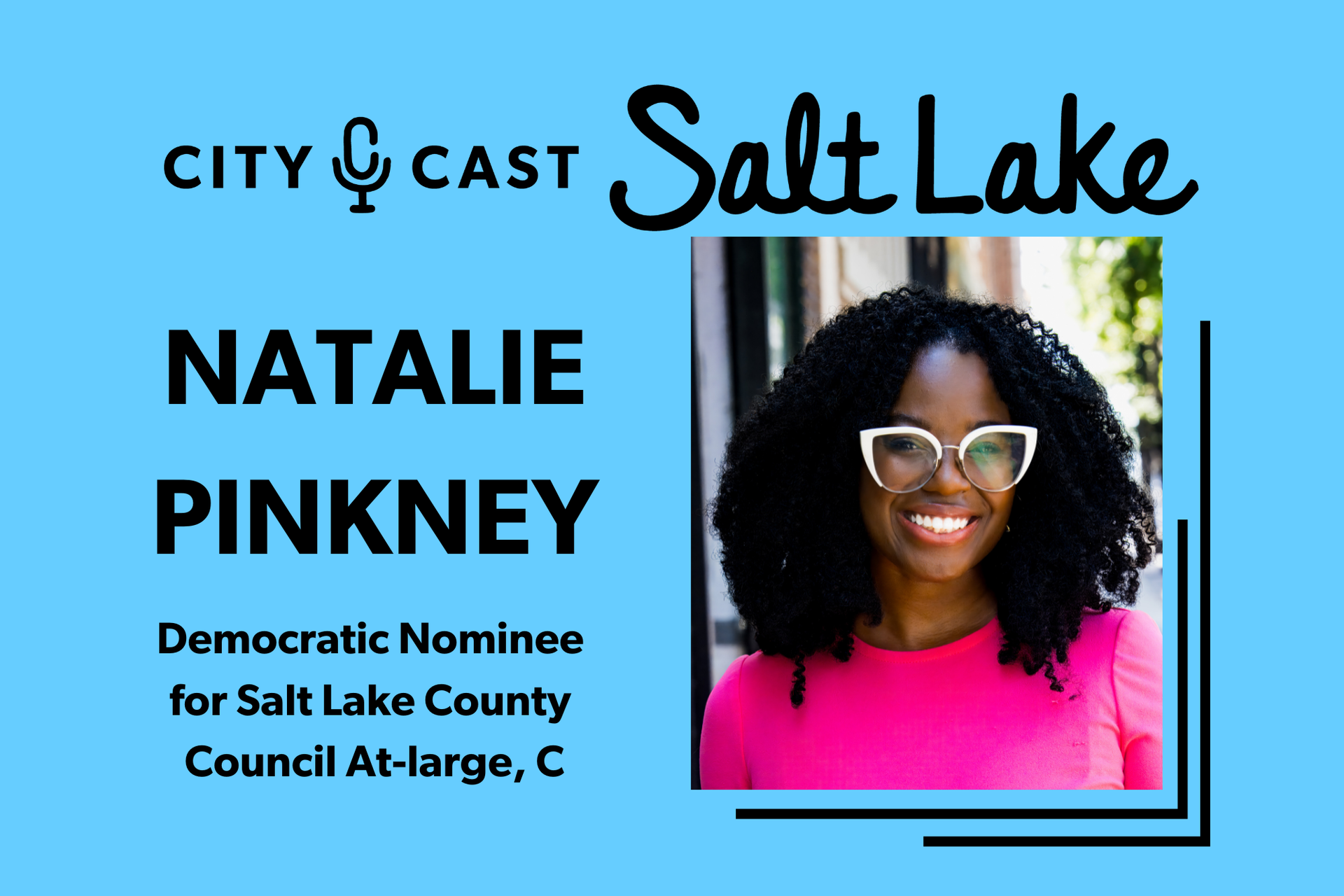
The race is on for an open seat on the Salt Lake County Council! Host Ali Vallarta asks Democratic candidate Natalie Pinkney about her plans for homelessness, affordable housing, and criminal justice.
Listen to our interview with Natalie’s opponent, Republican candidate Rachelle Morris.
Scroll down to read the transcript of our interview with Natalie Pinkney.
Learn more about Salt Lake County’s new homelessness plan.
Photo: Natalie Pinkney
Become a member of City Cast Salt Lake today! It’s the best way to support our work and help make sure we’re around for years to come. Get all the details and sign up at membership.citycast.fm.
Subscribe to our daily morning newsletter. You can also find us on Instagram @CityCastSLC.
Looking to advertise on City Cast Salt Lake? Check out our options for podcast and newsletter ads.
Learn more about the sponsors of this episode:
- Zoo, Arts, and Parks Reauthorization and Preservation Committee
- The Shop
- Babbel - Get up to 60% off at Babbel.com/CITYCAST
- Vote.utah.gov
- Nightmare on 13th
TRANSCRIPT
Ali Vallarta: Today on City Cast Salt Lake: one-third of our entire state lives in Salt Lake County. And the Salt Lake County Council has its fingerprints on some of our most pressing issues: affordable housing, criminal justice, and homelessness. Now, two candidates are vying for a seat on the County Council, representing all 1.2 million of us. And yesterday we talked to Republican candidate Rachelle Morris. Today, we are finding out what Democratic candidate Natalie Pinkney has planned. Quick disclosure here, Natalie and I have been friends for years. You can trust that the City Cast Salt Lake team approached our conversations with each candidate based on their records, their websites, and the issues Salt Lakers care most about.
Natalie Pinkney – Democratic candidate for Salt Lake County Council – as an at-large candidate, you are running to represent the 1.2 million people in this county. That is even more than our congresspeople represent in their districts. When you think about moving the needle on one issue, one thing for all those residents, what is it?
Natalie Pinkney: Great question. And it's really what I've been running on, which is empowering families, both financially and through housing. I think that is the biggest, hurdle that people are dealing with, not just about their right now, but also about their future when it comes to their family and to their life.
Ali Vallarta: What are, I mean, what's your big idea for moving the needle on that?
Natalie Pinkney: My biggest idea with moving the needle to helping families with housing is really working with the cities to increase our supply, streamline process, and also, understanding the qualities of each neighborhood.
So as we need to increase that supply, how are we being smart with our units, making sure people can actually buy homes, right? Not just for a lease, but also for sales. How are we building for middle-class families, people who are aging, who might have paid off their home, but feel like their property taxes are pushing them out.
So we need to consider and be really dynamic with how we increase our stock of housing in units, as well as respecting the different neighborhoods. You know, people get really scared when we talk about building more and wanting people to make sure that we understand, you know, neighborhoods need to be respected, neighbors that are moving in, but also working with the cities to say, where can we bring in more families and help to empower them for the future and also for children who are growing up here and making sure we can keep them in Salt Lake County.
Ali Vallarta: Yeah, I want to dig in on that notion of working with the cities as well, because when we talk about housing at the county level, we hear that cities are really key on that issue. They have the land use authority. So what do you think the county's role is in reaching all of these goals, in tackling this affordable housing crisis?
Natalie Pinkney: I see it in a couple ways. One, working with the cities to say, ‘what gaps are you kind of dealing with?’ You know, I'm on the South Salt Lake City Council, and sometimes I've heard from people that it's our process that can be a barrier, right? And I think for a long time, you know, zoning is kind of the word when you say at the local level, even at the county level, where people would be like, ‘Oh, our zoning is so messed up or it needs to be fixed.’ And I think I want to focus with the cities and say, ‘What are some kind of new ideas that we can do to make sure we're still doing all the necessary procedures to make sure we're building safe structures for families and for individuals, but making sure we can streamline it?’
Land is another one. You know, a lot of cities like South Salt Lake, they're really built out. So you might have to build up or try to figure out, you know, how can we get the land that is there that might be rezoned or reimagined to something else. As well as the county has a lot of land as well, so the county can in some ways help with the supply when it comes to housing.
So it really comes to a partnership with cities, working with the barriers that they have, and then being overall creative to make a segue to building more units and building more housing.
Ali Vallarta: Should the county build its own housing? Because, I mean, we talked to Riverton Mayor Trent Staggs on this show a couple weeks ago. And when we asked him about affordable housing, he said, ‘Yeah, we need more housing, but it's not a city's job to build housing. That is a developer's job.’ So, if you think that the county has a role here, is that just building housing itself?
Natalie Pinkney: It's funny that he says that because my understanding our governor said it's the city's role and I think a lot of people get frustrated when they see that, right?
You'll see the governor will say it's cities' responsibilities and then you'll see some cities who say it's not their responsibility or the county shouldn't have it. How I stand is I think it's everyone's responsibility. And if the county has land and can help with our supply, I think that they should. And I want to work with cities to figure out what that, barrier why it's a no, I think sometimes people are afraid of changes, but what I'm hearing is people want new housing and they want new units. It might depend on what that looks like in their area, but I think if the county can, it should develop housing.
Ali Vallarta: I mean, the housing crisis that Salt Lake County has and the amount of growth that Salt Lake County is about to see go hand in hand. It's, of course, one of the fastest growing counties in the state. We're expecting about half a million more residents by 2060. If you're elected, what types of policies or budget asks would you support to help plan for that growth?
Natalie Pinkney: I think a big thing is both transportation and I guess the overall infrastructure on how people move within our valley. We already are seeing everywhere in our corridor, especially in South Salt Lake – I feel like everyone drives through South Salt Lake, whether they know it or not. It's a busy road and we really need to get smart on how traffic is moved and that might look like increasing transportation, having smart traffic management systems, you know, really improving on our free fare days.
But, it also might look like, improving workforce services and investing in careers that they're scattered throughout our valley. You know, as we have one million more people, if all one million more jobs are still within Salt Lake City or the east side of our county, we're not going to really tackle the large issues that people are seeing.
So how can we build up more, I guess, hot zones so that people aren't just going in one area of our county, but they're also experiencing the southwest part of our county and the west part of our county and the southwest part of our county. So we have to be really smart on how we're building our transportation, how we are welcoming new businesses and encouraging them to scatter throughout our county and also again, working with the cities to say, ‘What is your 20 year plan?’
Every city has both a general plan and a master plan that's always being developed. So working with them to say, ‘Where are the barriers? Where do you feel the most weakest? And how can we, the county, step in?’
I think a lot of times cities can see the county as kind of the bank, the money. And I think that's where we can help in those ways. But transportation and smart infrastructure, I think, would be the way to go.
Ali Vallarta: Yeah, you said a million more people. I think you mean half a million, half a million more.
Natalie Pinkney: Yeah. I guess I mean by 2060, I guess. Yes.
Ali Vallarta: Yeah.
Natalie Pinkney: You know, we're going to really grow. Yes.
Ali Vallarta: It's funny that you bring up drive-thrus, driving through South Salt Lake because – I have to ask you, like, councilmember, you are on the South Salt Lake City Council. South Salt Lake has become known to a lot of Salt Lakers in recent years as the drive-thru epicenter of Salt Lake City. We've seen so much of, you know, what we thought was the plan for downtown South Salt Lake become really congested with drive-thru restaurants. And I think a lot of people feel that that's not necessarily what they want in a downtown.
What would you say to people who are critical of the way South Salt Lake has approached growth and might be nervous about that being scaled up in the county?
Natalie Pinkney: I would say I totally understand that nervousness because I love a lot of the development that we've done in South Salt Lake and the way we've grown. I'm on the arts council and we do a lot in our creative industry zone, which is on South Temple, where our breweries are. So if you haven't checked it out, you should. But I have been also critical of how we've built out our downtown. I've talked to the neighbors who live right there on 21st. For folks who are trying to keep up with us it's really where you enter is 21st. You'll see the big bowling pin. You'll know you're in South Salt Lake and right in that corridor, people want a city center where they can shop and they can hang out and they can build community. I think a lot of neighborhoods feel like there is a lack of that community and that's what I wanted to see in our downtown and I've pushed for that. I have voted no against a lot of our drive-thrus, even if I do love the drive-thru, it's not about the business. It's about what people want and I know we do have a new development coming to our downtown that does address that, that I'm excited about and I think when it comes to the way people see the development of their city, speak up about that, you know, I see my role as representative to share that voice of frustration and that's what I've done to be able to now see in our city, a city center that will come that will have the residents in mind. You know, I think cities only have so much ways to make money that when they see land for opportunity to grow, they think of the fastest way to bring that in. And unfortunately, that becomes a drive-thru, that becomes a car dealership. And yes, a place with restaurants and shopping isn't going to bring in as much revenue as if you sold one Tesla, but it's going to bring the community that we want. And I think that's the most important part. So that is coming to South Salt Lake.
And that's something that I would work on at the county is working with each city to say, ‘We understand your budget needs, but we also understand that your role is to be a representative of the voters. How do we make sure that the city can be a community for them and they can live and they can thrive?’
Ali Vallarta: I want to talk about homelessness because of course, this is often forgotten by Salt Lakers, but Salt Lake County is the continuum of care with the federal government, which means that they get a lot of the federal government's homelessness resources. On your website, you say that one way to address homelessness is by increasing shelter capacity.
Now that is not currently in the county's new five-year homelessness plan, though it is something the state is looking to do with a proposed 600-bed shelter. Why is that something Salt Lake County should lead on?
Natalie Pinkney: I think right now, you know, Salt Lake County, we're one of the biggest counties and a lot of the folks who need services do live in Salt Lake County.
So I do think it's a responsibility of Salt Lake County, but I don't think we should be the only county with that responsibility. In my role on South Salt Lake City Council, you know, I go to the legislative session each year, talking to cities in the county, but also to other counties about really our shared responsibility when it comes to increasing shelter capacity in South Salt Lake.
We have a men's resource center that, in a lot of ways, hasn't been at capacity. What happens with the shelters that are in Salt Lake City, Midvale, South Salt Lake, they're not actually at a hundred percent capacity. So then we have to have an emergency shelter, like in West Valley, which I think a lot of people don't even know we have these kinds of smaller emergency shelters cause there's not enough capacity. So let's work with what we already have, but also, how can we explore more specialized shelters to really help cater to specific populations in South Salt Lake? We've learned that, you know, our motel is going to be maybe transformed into a family shelter. And we've done a lot of burden when it comes to serving these populations, and we are happy to do it in South Salt Lake because we have an amazing after-school program where we can help support these families, but not every city is equipped for these type of programs. So, what we really need is for more cities to help and to help expand and to explore that shelter capacity.
I know that's not what people want to hear, it's the last thing people want to hear, but I really do believe when it comes to homelessness, we can either incarcerate or we can house them and either way, we're going to have to pay for it. And we know incarceration is going to cost more than just providing shelters.
And in the meantime, that might mean expanding those shelters while we can work on expanding permanent housing or housing that works with this population so we're not in this kind of cycle over and over again. But I really do believe that the best practice would be to ensure that there's privacy and dignity and safety overall when it comes to shelters and housing.
Ali Vallarta: I mean, if shelters are expanded in Salt Lake City, South Salt Lake, places that are already taking on a share of this burden of figuring out how to house people, I think it's going to be a really tough pill to swallow whenever we see new shelters that are being proposed in other parts of the county.
Those cities often have immense pushback. I know Mayor Silvestrini dealt with it in Millcreek. How do you sell residents on more shelters, on expanding the shelter system?
Natalie Pinkney: You know, there has to definitely be and I know, yeah, mayor of Millcreek, as you just mentioned, had to have a conversation about compassion and I think that is part of it and also about values as well of when it comes to homelessness, we all want to solve the issue.
How do we want to solve that issue and what values do we have to connect with? That would be a conversation that I have. And if that ends up with, we rather not expand and have more shelters, we rather expand the jail and incarcerate, then that becomes a solution. But I'm hoping people are more compassionate and want to address the root cause, like the Justice and Accountability Center bond that has been proposed.
Those are ways that when we talk about our taxes increasing, we don't want taxes to increase. Taxes increase because services increase. And homelessness is a service. And we really have to address that root cause. So I understand that frustration when it comes to communities. And I just hope that we can really have a compassion and a value standpoint to say, we're going to have to pay for this one way or another.
The best way to pay for this is not going to be using our criminal justice system. It's going to be housing. It's going to be shelters. And also letting people know that these are individuals who are not just dealing with mental health or substance abuse. There's a large population who are working. I've talked to a lot of folks who suffer and deal with homelessness, and they are working nine-to-five jobs. They're living in their car. Family homelessness is increasing. So we all are really only one step away from being in the same circumstance. So there has to be some type of compassion that we can give.
Ali Vallarta: I'm interested to hear you bring up the role of criminal justice here, because part of Salt Lake County's new five-year homelessness plan includes expanding the jail and building an alternative to jail. And voters are going to decide if they want to pay for that through a tax increase, through a $507 million dollar bond that's on the ballot this year. How are you going to vote on that?
Natalie Pinkney: I'm going to vote yes on the bond. And this is why: what we know is Oxbow has to be dealt with either this year or eventually in another year. And this is a bipartisan initiative, right? So I think we can see that a lot of people have buyout. There was long conversations about the resources that are need. There are a lot of concerns when it comes to the Oxbow Jail. So one thing we know is we do need a new jail. And because we know we need a new jail, there's an opportunity to say, ‘Do we just want to build more cells to put people in?’ Or do we want to, again, decrease services so that we don't have to, every five years, say we need another pod to put people in which is going to mean we need more officers, which just means more taxes.
So, to me, the Justice and Accountability Center is a place for people to really not come back to that. I've shared my story a lot. I was raised in a multi-generational family by my grandmother and my father. And I was raised by both of them for most of my childhood because my mother was incarcerated. And she's never returned back to that system because people at the county believed in her and had resources to make sure she didn't return. And that's what this is about. Making sure people don't return, that they're not second-class citizens for the rest of their life – not able to have housing, not able to get a job, and then, you know, on our streets. So I think it's a big possibility to address the root cause and to eventually down the road say, ‘Now we don't need a property tax increase because we are actually addressing the issues of our community.’
Ali Vallarta: Let's talk about the politics of Salt Lake County. So right now, there is a slight Republican majority on the council. Salt Lake County is one of three counties in the state that's a reliable Democratic stronghold, though registered Republicans do outnumber Democrats. Where I'm going with this, is, how do you make sure that residents across the political spectrum are represented in your decision-making on this council?
Natalie Pinkney: I think it comes down to listening. I think right now, if you — and a lot of Utahns have been asked, what's the most frustrating part about our elected officials? They don't listen. And I think that is the biggest thing that I want to do is listen to people and make the best decision. I am running as a Democratic nominee, but I've done things that people wouldn't say Democrats do, like vote no against 110% property tax increase.
You know, I stand for a lot of things, understanding property rights, the investment in our community, wanting a better, safer future. I believe that we all want better values than divide us. And I believe that's what can bring us together. When I go to a door to someone that maybe we disagree on things that we feel are a threat, we don't disagree that we want our children to be safe. We don't disagree that we want our neighborhood to be safe. And that's the person I plan to be and to represent.
Ali Vallarta: On the note of campaigning and door knocking, a really iconic part of election season is the campaign song. This is a podcast. We love audio. I want to ask you to pick a campaign theme song.
Natalie Pinkney: I love this. Cool question. And I'm going to pick the song I actually picked at convention, you know, and it was actually suggested by my husband. It's by Lorde, "Team." And I love that song so much because there's a lyric in there that says, "We live in cities you don't see on the screen and we're all on each other's team."
And I just think it's so fitting, right? Like no one... one, a lot of people were shocked to even know Salt Lake County exists. And a lot of people don't really think of salt Lake City or Salt Lake County as a big place that you do see on the TV screen. Maybe a little bit now with some new reality shows coming out.
But I think it's a good reminder that we are on each other's team, that we're all working towards the same future. So I've picked that song.
Ali Vallarta: It sounds like you picked it a while ago.
Natalie Pinkney: Yes. And I picked it a while ago. And it's just been, it's been a theme since then.
Ali Vallarta: Natalie Pinkney, Democratic candidate for Salt Lake County Council At-Large C. The C always gets me. Thank you for your time.
Natalie Pinkney: Thank you, Ali. Appreciate it.
Ali Vallarta: That is all for us today here on City Cast Salt Lake. If you missed our conversation with Natalie's opponent, Republican candidate Rachelle Morris, it's already in your podcast feed. So give it a listen.