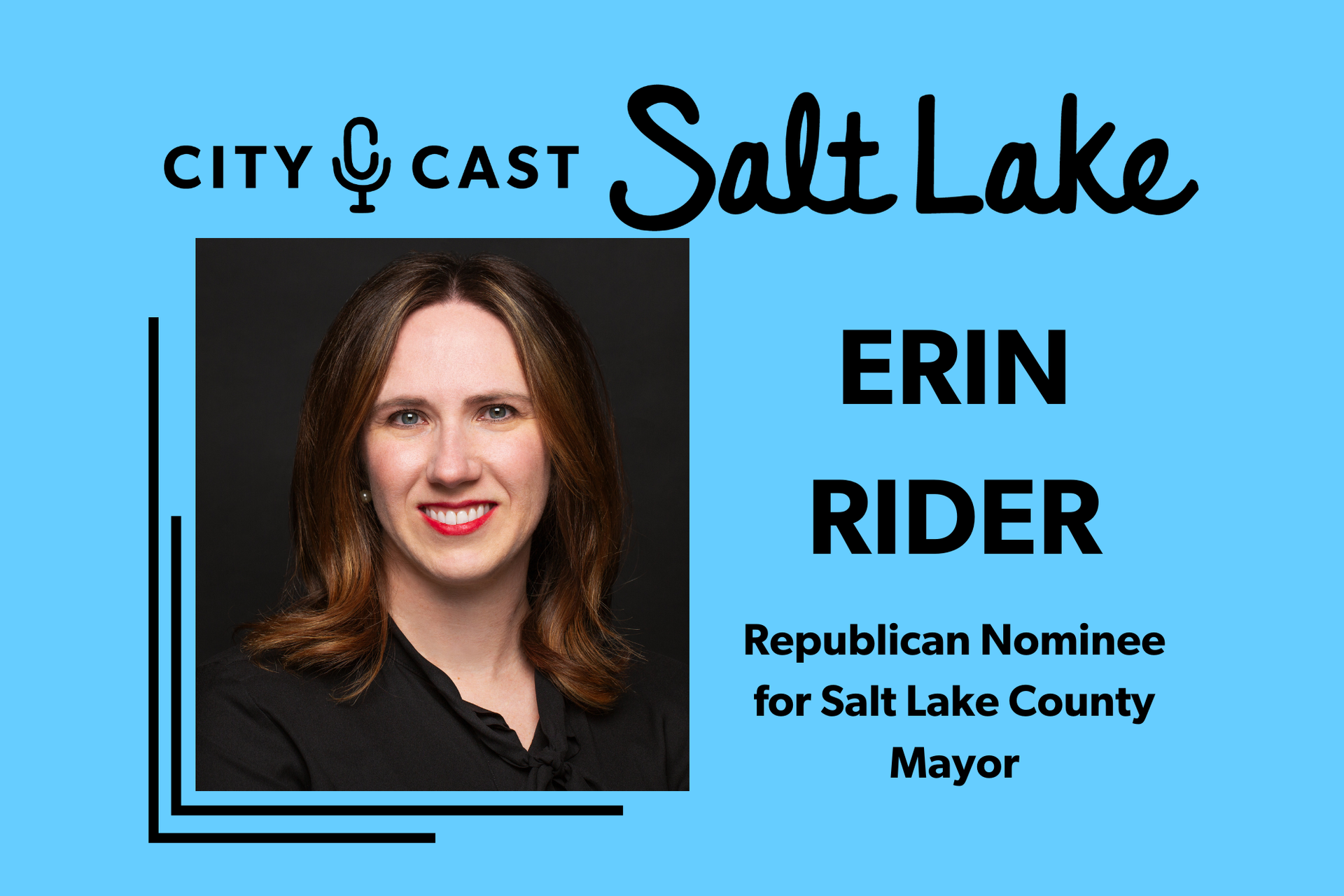
The Salt Lake County mayor represents a third of Utah’s population, and the race is on your ballot this fall! Host Ali Vallarta talked to Republican candidate Erin Rider about the $507 million public safety bond, homelessness, and public transit.
Listen to our conversation with Democratic candidate and incumbent Salt Lake County mayor Jenny Wilson.
Scroll down to read the transcript of our interview with Erin Rider.
Learn more about Salt Lake County’s new homelessness plan.
Photo: Erin Rider
Consider becoming a founding member of City Cast Salt Lake today! It’s the best way to support our work and help make sure we’re around for years to come. Get all the details and sign up at membership.citycast.fm.
Subscribe to our daily morning newsletter. You can also find us on Instagram @CityCastSLC.
Looking to advertise on City Cast Salt Lake? Check out our options for podcast and newsletter ads.
Learn more about the sponsors of this episode:
TRANSCRIPT
Ali Vallarta: Today on CityCast Salt Lake: Salt Lake County is home to 1.2 million people and 23 different cities. And guess what? The county has its own mayor and council as well. People with a lot of power making big decisions from homelessness to our jail. And in just a few weeks, you will get a ballot. Asking you to vote for mayor of Salt Lake County.
So let's get to know the candidates. Yesterday we talked to Democrat and incumbent mayor Jenny Wilson. Today, meet Republican candidate Erin Rider. Now, quick disclosure for you. In a previous job, I worked for Jenny Wilson. It was 2018. But trust that we approached our conversations with each candidate based on their records, their website, and the issues Salt Lakers care most about.
Erin Rider, Republican candidate for Salt Lake County Mayor. This county is home to more than a third of the state's population, 1.2 million people. It's a lot of lives that you can impact in this role. When you think about moving the needle on one thing, what is it?
Erin Rider: So one of the big reasons I'm running is quality of life. And that is, to me, the primary purpose of the Salt Lake County government is to preserve and maintain the quality of life in Salt Lake County. It's the reason that I moved back to Salt Lake after being away for a few years for grad school and for work. And it's one of the things I think is frankly at jeopardy right now and is a reason why I'm stepping into the race.
So when I think about moving the needle, I think about preserving and really safeguarding all of these key elements of life in Salt Lake County that have brought or kept so many people here in this beautiful valley.
Ali Vallarta: Do you have any examples, like specific quality of life aspects that you think are at jeopardy and something you would do?
Erin Rider: Absolutely. So, you know, I grew up here in Salt Lake County and went back east for grad school and in Washington, DC. And when I was back east, I loved my time back east. I thought it was so much fun. I loved Washington, D.C. I went to Georgetown University, got my JD, MBA there. And then after I graduated, I went up to Boston for a couple of years and worked in Boston for a large law firm.
And as much fun as I had on the East Coast, it was quickly apparent to me that it was not a place I wanted to stay forever. I missed that quality of life in Utah. And it's one of the things that brought me back. So I came back in early '19, specifically with the intention of putting down my roots here.
But coming back and seeing some of the changes in Salt Lake County from the time I'd been away, those are some of the things, to answer your question, that I'm thinking about. Things like the cost of living, you know, housing affordability, just general cost of living in general, homelessness, that's a huge issue right now.
All of these different kinds of factors, even crime rates, all of that had changed so much from the time that I had been here and the time that I had been back east. And it's one of the things that got me into this race, thinking, look, you know, I, I know everybody talks a lot about not becoming California, but I also think that we see some of that trajectory here, right?
We use them as a, lesson for a reason and it's not just California. I look at Portland, look at even Boston and D. C. It's just difficult to live in those cities and I don't want to see Salt Lake County become the next Portland or the next Boston even or the next D. C. We have a lot of dynamics here that we need to make sure we preserve and if some of these elements are getting out of hand, these are all things the county plays a role in and has responsibility for, well, it's time to make some changes there to change that direction of the ship.
Ali Vallarta: The top issue on your campaign website is leadership. And in your words on the website, "Salt Lake County faces a vacuum of leadership." Now, you haven't held elected office before, but part of the job of county mayor is to bring all 23 city mayors in the county to the table. What's an example of a time you brought together stakeholders with competing ideas and helped them find a solution?
Erin Rider: Yeah, absolutely. So I'll talk about two different things to answer that question. First, in my job as a corporate attorney, I do a lot of mergers and acquisitions, and part of the role of a corporate attorney in one of those transactions is to be the quarterback of the deal. And what that means is that if I have a client who's being acquired, I need to make sure that I have the right people at the table to help me make sure I'm not missing key components of the deal as I'm negotiating it with the other side.
That means I need a tax attorney involved. I need a patent attorney. I need an employment attorney, whatever's relevant for that deal, I need to make sure those people are there. But at the end of the day, it's my job to advocate on behalf of my client and to work with the other side. Now, in working with the other side, especially in the context of a merger, you're usually looking for a win- win situation because oftentimes You have people who are going to be working together after the deal's completed.
You want them to have a good relationship. You want them to build a future together. And so, even when you're working on opposite sides, you're doing it with the end goal in mind that we need this to be a successful endeavor so that this organization continues to thrive, which is why the merger is happening in the first place.
Then, in addition to that, I've been involved in a lot of community service initiatives since I've come back to Utah. One of them is the My Hometown initiative in West Valley City, and one of the things that I got involved in as part of that group was I went to the leadership and I said, 'look, if you really want to see change happen in some of these areas, you need youth participation.'
And they said, 'great, go do it.' So I started a community youth council to bring some of these teenagers to the table and say, what do you want to see out of your community? How do we get you in touch with civic leaders, community leaders, business leaders, religious leaders, to make sure that you have a voice in what's going on here and not just sort of here by default as other people are making decisions.
So again, you know, as I look at the county mayor, I see this, I see the same kind of dynamics happening there. Any issue that happens, I mean, these are decisions that affect people's lives and you need to make sure that you have all the information you need before you make a decision on that. So I want to bring other people to the table.
I've been talking to a lot of the mayors in the county. I've been talking to a lot of the city council members, a lot of community leaders to say, what do you need from the county? How can the county be more supportive and a more service- focused organization to help you address the issues that you're facing as a city. And how can we do that to help you out?
So yeah, I think in that sense, they work very close together because You need to have people at the table, whether or not they're quote unquote on your side, because you need to understand every angle of these before you make a decision that affects somebody's life.
Ali Vallarta: What are you hearing from other mayors? Because we've been talking to mayors in the county too. I'm curious if they're telling us both the same thing.
Erin Rider: I think the general sense is that the county can often be a roadblock in a lot of issues that are, that need to take place around the county. And, and in some ways, this really isn't surprising.
If you think about it, I think one of the big issues right now is that the county is going through an identity crisis. 20 years ago, the county was both a municipal and a regional government, and it needed to be because so much of the county was unincorporated. But today, that's not necessarily the case.
We're wall to wall city at this point. And a lot of those cities have taken on the municipal responsibilities that the county used to be responsible for. But the county hasn't really adapted to that change very well. And what it's doing is it's causing. conflict between the county and the cities where the county is still trying to hold on to certain things the cities are trying to do themselves, and then that's when it's the you end up with a situation where the state gets involved and the legislature starts passing bills that only affect Salt Lake County.
To give you an example of this, the Unified Police Department, the split from the Sheriff's Department is a perfect example of this. A lot of cities had already started pulling out of the UPD. They felt like they weren't getting the services they needed. They could do it better on their own. And then, but the county wasn't really making any changes to address that.
So the state steps in and says, okay, well, then. We're going to pass a law that only affects Salt Lake County, and we're going to separate out the UPD from the Sheriff's Office, and the cities that are still part of the UPD can decide to do whatever they want with that. So, you know, you've seen some instances of this where the state has gotten involved, and to me, that's a problem, because if the state's taking time out of its legislative session to pass laws that only affect Salt Lake County, this is one of the reasons why leadership is number one on my website.
Because, where is the mayor in this process? Why is the mayor not involved in these decisions? And I think it's because the mayor, who's been there for 20 years, is still holding on to the way the county used to be, not necessarily looking forward to the way the county needs to be.
Ali Vallarta: And when you say been there for 20 years, you mean in county government because the current mayor was formerly on the county council.
Erin Rider: Correct. Yeah.
Ali Vallarta: One of the issues where the county still does hold quite a bit of influence is around homelessness. And part of that is because Salt Lake County is the continuum of care, which basically means that they handle a lot of the federal dollars related to homelessness that we get. And one of the issues as well, where the state is forcing cities and counties to work together towards a common goal is homelessness. So with the county's response to homelessness, what do you think is working and what would you do differently?
Erin Rider: Yeah. Um, this is one of the top issues that I, uh, hear from people as I campaign around the county. Um, you know, it's housing affordability, homelessness, taxes, and then you get some region specific issues in there as well.
Things like Abravanel Hall and, uh, and the hockey arena. So homelessness, there's no question that we need to do something about this. And when I talk about the trend of becoming some of these other cities I think it's partly because of some of the issues we're seeing with homelessness right now. I think the county has been very much behind the ball in dealing with this and has been very delayed in the process.
And that's causing a lot of issues because yes, cities need to be involved and cities need to take ownership. But this isn't just a city problem at this point. You've got each city is dealing with this in its own way. And yet a lot of the resources are concentrated in downtown Salt Lake and the cities don't necessarily have the capacity to handle it entirely on their own.
So I know that my opponent has put out there a plan about homelessness. I think it's years too late in the making, frankly. And now we're talking about it. You know, a bond. I know you guys have discussed the bond on your podcast in the past. $500 million in taxpayer dollars to address this. And I look at this and I think we're just throwing money after a problem and we don't actually have any legitimate way of addressing this.
And, you know, I'm sorry, but there's nothing innovative about another tax increase. So, you know, I want to go in there. The thing about homelessness is there's no silver bullet with this. You have to be extraordinarily proactive and you have to deal with a variety of issues because in many ways, each person's experience leading to homelessness is very different.
And so I'd like to address the entire pipeline of how do we prevent people from getting on the street in the first place? And then once they're there, how do we help Decrease some of those barriers so that when they're ready to they can move forward and find. You know, places to live and jobs. And that's looking at things like a government ID.
If you don't have a government ID or a physical address, how do you qualify for a background check for an apartment or for a job? And how do you get the government ID if you don't already have one? There's some pretty big barriers just in that category that I think that we could deal with. It would take down a lot of these roadblocks and I don't think it requires hundreds of millions of taxpayer dollars to do it.
I think we need a little bit of innovation in how we're looking at this problem and to deal with the things, you know, even some of these rehab centers. Sometimes people have to pass a line of drug dealers on the way in and on the way out. Well, that's a huge problem. How do you get people on the road to recovery if they're constantly surrounded by influences that are preventing them from getting there?
So things like that that I want to look at and just find some new ways of looking at these problems because again, throwing money after them is not the solution.
Ali Vallarta: The county's five year homelessness plan, which you mentioned, does have buy in from Salt Lake City Mayor Mendenhall and Governor Cox. There's a big focus in there on criminal justice and, you know, part of that $507 million bond would, Pay for expanding the jail. Building an alternative to jail. In terms of the criminal justice piece of this, what thoughts do you have around that? How do you approach that without asking for more money?
Erin Rider: You know, I think that, again, this is one area where I look at this and I think it just feels so tone deaf to be asking for $500 million in taxpayer funds plus interest at a time when people are feeling so financially strapped. And a couple years ago, I believe it was, the county allocated about $50 million to increase the capacity of the Oxbow Jail. The existing Metro Jail is only about 20 years old. And so I just have to wonder, well, was the money wasted two years ago?
Or is the money being wasted now? If we were increasing that capacity two years ago, why are we suddenly talking about increasing capacity again? Why wasn't That job done two years ago. So to me, I don't buy the idea that this is the only option on the table. It's certainly an option, but I don't think it's the only option.
And there are ways of dealing with recovery. There are ways of looking at this that don't require $500 million. You need a few million to address some things here and there. Okay. I think people are probably fine with that because law enforcement is something that we all buy into and accountability is very much a part of this.
You have to hold people accountable for their actions regardless of where they're living. And, um, that's an important part of, You know, human progress, but doing it at a cost of $500 million especially when the county's budget is already at $2 billion a year, that just feels I just can't believe that's the only option available.
Ali Vallarta: This bond's going to be on your ballot when it gets mailed to you this fall.
Erin Rider: I know.
Ali Vallarta: Can I get you on the record? How are you going to vote? I don't need to know the whole ballot. Just the bond.
Erin Rider: At this point, you know, I'm not a fan of the bond. I think there are other ways of looking at this and each person can certainly make their own decision on this.
And I know that members of the council, even the members of the council who voted to put this forward on, on the ballot, many of them have clarified that their vote in favor was not necessarily a vote in favor of the bond itself, but a vote to give people the choice. And that's a very different kind of affirmative vote. So I think we let people decide how this goes. And look, if it passes and I am in office in January, then, you know, we'll just make sure that we're good stewards of that cash as we move forward.
Ali Vallarta: Since we're talking about money, let's talk about the budget because you brought it up. Um, a little under $2 billion. Salt Lake County, though, is one of the fastest growing counties in the state. It alone is home to a third of the state's population. We're expecting about half a million more residents by 2060.
It's no secret that this kind of growth puts a lot of pressure on budgets. Now, the Republican party famously platforms on not higher taxes. And you've brought up that you, I think in your words, you think a tax increase is not a creative solution. So how would you shore up Salt Lake County's budget to plan for the growth that's coming in lieu of that?
Erin Rider: Absolutely. There are two big things I want to do. Day one, I want to do a full audit of the county's operations and budget and figure out, you know, again, I mentioned this identity crisis that the county's currently in. I would love to, part of that is I want to figure out what Are the core competencies of the county as a regional government, as opposed to a municipal government, and if the county doesn't need to be involved in a certain element of that, you know, certain part of that, then okay, we move forward, we move on, and we shift it, right size it in a way as to what it needs to be going forward.
Part of that audit and part of that plan would be putting in place a 10 year plan for the growth and development of the county on a regional level. And so this is where you would look at what are the issues, you know, what are those, those core competencies of the county and how do we make sure that our resources are going to support those in effective ways.
And the thing that bothers me about the budget. Yes, Salt Lake County is the largest county in the state. Yes, we've got a third of the state's population here. So the budget is certainly going to be bigger than a lot of other counties around the state. However, the resounding message that comes from the county is that there's never any money to do anything.
And so you look at a lot of the assets that the county owns, a lot of the rec centers. Um, Abravanel Hall is a big part of this. Um, just the message that comes to people who have to work with the county is that there's no money. And I look at that and I think, how do you go through $2 billion a year, and yet you don't have money to take care of the most basic things that you're responsible for.
And so that's what concerns me, right? Where are those dollars going? And it's very unclear from the outside how that money is actually being spent. And the mayor is responsible for setting the budget at the county level. The council certainly has input and the council ultimately has to approve the budget, but it's the mayor who actually puts that budget together.
So if you're seeing an increase in the budget and an increase in taxes, it's usually driven by the mayor, not necessarily by the council. So, you know, looking at this, I just, again, right, like, I don't have all the dollars. I'm not there every day. I don't have all of the inside as a candidate. However, that's, you know, and that's the purpose for doing this audit.
So where is this money going and how do you work with some of the organizations that are out there already to find solutions to these problems that don't just require additional tax increases, because again, $2 billion, it's a lot of money. The only budget in the state that's bigger than that is the state itself.
Ali Vallarta: Yeah. The thing about the county budget that I've noticed a lot recently, as I've paid closer attention to it, is that the county is one of the state's biggest arms when it comes to public safety. The courts, the district attorney, um, you know, you mentioned policing, which the county sort of kind of ran for some cities for a while. Um, You're a lawyer, so you're very involved in our criminal justice system. You know how expensive it can be to operate. Do you have ideas for how to make criminal justice at the county level more affordable?
Erin Rider: Yeah. So a lot of that is working with the DA's office and the DA, of course, is an independent elected official.
Um, and you know, Actually speaking about that for a second, one of the things that I've found interesting is that the Salt Lake County DA's office offers some of the higher salaries in the state for public attorneys that are working in offices like this. To the point that you actually have people, attorneys who are leaving the Attorney General's office and going to work for the Salt Lake County DA.
But the problem is once they get there, There are a lot of inefficiencies and a lot of problems within the Salt Lake County DA's office. And so you have people who are leaving the Attorney General's office, going to the Salt Lake County DA, and then leaving the Salt Lake County DA to go elsewhere in the state.
It's become a revolving door. And that's really concerning to me. If you're paying, you know, again, I'm an attorney, I've worked in law firms, I completely understand the dynamics of the economics around this. And if you have salaries that are, you know, the highest in the state and you can't retain good people to work there, that's a huge problem for me, right?
So that alone is a piece I'm very interested in. Um, again, there's, you know, a lot of this falls under the district attorney's purview themselves, but the budget portion of this would come from the mayor and the council. The mayor and the council are the two policymaking organizations in the county and all the other independent offices provide input and help execute on, um, on the, you know, the things that are happening in the county.
So from a criminal justice perspective, that's one area I'm very much looking at the decisions as to what kind of cases the DA decides to prosecute. That's a really interesting component of this to me. There are a lot of cases that are not being prosecuted by the DA right now. And if it's a question of resources, then let's talk about those resources.
But again, if you're paying the highest salaries in the state, And you don't have resources that doesn't add up to me, right? So components like that, looking at our, um, at our jail system and I'll clarify, I'm not opposed to strengthening our jails if that's what they require. My concern is the cost, the proposed cost of what's on the bond this year.
And, um, but, you know, that doesn't mean that we shouldn't be putting money into our jail system. It just, I just think the cost of doing that is, exorbitant.
Ali Vallarta: I have to ask you, the Salt Lake County DA's office has gotten a lot of flack from the state legislature recently. If you're the mayor of Salt Lake County and Sim Gill is your DA, you gonna stick up for him?
Erin Rider: Uh, as long as he's doing his job, you bet.
Ali Vallarta: I want to talk about the politics of Salt Lake County. So if you become mayor, you'll be the first Republican to hold the office in 20 years. Salt Lake County, I would probably describe as purple ish. There, it certainly depends on where in the county you are, but it, it is one of three counties in the state that's kind of a reliable Democratic stronghold, though registered Republicans do outnumber Democrats.
So it's like, it's a mire here, but I want to know how you would make sure that residents of all political persuasions are represented in your vision for the county.
Erin Rider: So if you look at the numbers of Salt Lake County, Salt Lake County is actually technically pink. If you really look at the breakdown. It's about 40 percent registered Republican, 20 percent registered Democrat, and then the rest fall into that independent unaffiliated mark.
So if you're, if you're looking at the numbers that way, it's about, you know, it's really kind of pink. I think one of the reasons why Republicans have not done better in Salt Lake County If I'm being perfectly honest is because Republicans in Utah are not terribly great at running general election races in Utah.
We kind of take it for granted that we win primaries and then that's kind of the end of the story, but that's not the case in Salt Lake County. Even if Salt Lake County's pink, it's not red. And so you need to run a race from a general election standpoint, not just a primary standpoint.
Looking at the county as a whole, one of the things that concerns me is that I hear a lot of sentiment from outside of Salt Lake City where people feel like the Salt Lake County mayor has basically become a second Salt Lake City mayor, and there's a strong feeling throughout the rest of the county that the county mayor has basically just abandoned them.
And you feel that especially in the west and the southwest parts of the valley, where they have a lot of needs from the county right now, and they cannot get the county mayor to actually put in the effort and the resources that those areas need. As an example of that, in Herriman, there's no public transportation system anywhere in the city of Herriman. And They recently put a SLCC campus in Herriman.
It's a combined SLCC University of Utah campus, and the agreement was to put that in with the county putting in a bus system to get to the campus. A lot of SLCC students use the bus to get to school. Well, the campus went in, but there's still no bus system. And so the transportation, the infrastructure on that southwest part of the valley is a huge, huge issue.
So one of the things I want to do is make sure that we kind of restore that balance to say, yes, Salt Lake City is very important. It's our capital city. It needs resources. We need to make sure that it's a focus. But we have a very large county with a lot of people who live in the rest of the county. We need to put some time and effort into the rest of the county, not just into Salt Lake City.
Ali Vallarta: I just want to note, you mentioned there are no bus stops in parts of the South County. I hear you. We actually talked to Mayor Trent Staggs from Riverton about this, and he was very frustrated. But There is also something to be said for like, how much cities pay into UTA, Utah Transit Authority, and what they get in return, despite what population might look like.
Erin Rider: Oh, is that a question?
Ali Vallarta: Do you think, I mean, do you think that's like a fair assessment? Like, A huge percentage of UTA's budget comes from Salt Lake City. Salt Lake City gets more access.
Erin Rider: Yeah, but we're talking about no transportation in the Southwest Valley. I don't know that you, I don't know that you need to have the same kind of infrastructure in Herriman or Riverton that you have in Salt Lake City, but right now there's nothing.
I mean that, you know, it's a pretty low barrier, right? Like, Just a bus system alone is not that difficult. And the state allocates money to the county specifically for infrastructure purposes. So where, why isn't the county looking county wide, right? This is where I go back to that regional development plan.
Where is the growth going to come? Where are the, where do the resources need to be? Maybe Herriman doesn't really need a lot today, but But they might 10 years from now, uh, based on the growth trajectories that we're seeing. We need to be ahead of that. Infrastructure development in the county has often lagged behind development.
And so you get a lot of, um, you know, homes being built and communities being built that don't actually have the infrastructure development. I'd rather work with the cities and with the state to say, where do we think this development needs to go? And let's get the infrastructure there first, or at least side by side.
So that when the people come, you know, they have a way to get around.
Ali Vallarta: If I'm being totally honest, I think most people in Salt Lake County don't even know that Salt Lake County has a mayor. I am so often in conversation about, and like, can't blame them, right? Like it is an unusual sort of system of government we've got going on here.
How would you make sure that people in Salt Lake County know what you're up to?
Erin Rider: Yeah, a lot of that is being present in the community. And that's one thing that I'll hit my opponent on is that she is not present in, in the County, maybe in Salt Lake City, maybe, but not in the rest of the County. You look at, uh, and you know, I get this question all the time.
Well, why do we have a Salt Lake County mayor? That doesn't make sense. Or I'll, you know, people will say, Oh, I wish I could have vote for you, but I live in Sandy. I do want to clarify that if you live anywhere in the boundaries of Salt Lake County, anywhere in this Valley, you will be voting for the Salt Lake County Mayor and many other Salt Lake County offices in November when your ballot arrives.
It's just a different layer of government. And so I think, look, there's a lot of stagnation in the county government right now. I will be the first to thank my opponent for her service, but at some point you just kind of run out of ideas. And I think the wind is out of the sail. And it's One of the reasons why people just don't know what's going on in the county.
I've actually been impressed that a lot of people can separate out the county's responsibility from the state and the federal government, but a lot of people can't separate, can't separate out the county from the cities. And that to me is a big problem, right, Where you don't understand what is your county government doing as opposed to your city government, and yet you pay all these taxes into a county government, and you have no idea what it does.
So just bringing some awareness to that, really re engaging with these communities, rebuilding ties with the mayors and the city council members. And You know, really kind of putting an effort out there to say, yeah, you pay taxes to the county and we're going to show you what we're doing with those dollars and why it's a good investment for you so that you don't feel like it's just yet another layer of taxation.
Ali Vallarta: Okay, my last question for you. On the note of campaigning, the campaign song is a very iconic part of election season. This of course is a podcast. We love audio. I want to ask you to pick a campaign theme song.
Erin Rider: You know, when I think about this question, I think about this in terms of what really gets me excited about, you know, kind of a little bit of a pump up song, a walk up song.
Ali Vallarta: Okay. Okay.
Erin Rider: The one that immediately comes to mind for me is Beyonce's "Run the World." And I just, for me, that is A great way to get myself excited about what I'm doing and to remember that, hey, look, there are so many, you know, taking this to a little bit of a meta standpoint, there's so many incredible people, particularly women here in this county who do unbelievable amounts of work, um, both privately in their own homes, as well as publicly.
Anyway, so that song always kind of taps into that notion that there are communities and there are people here that are just running the world and doing a fantastic job at it, even if they're not always getting the recognition for it.
Ali Vallarta: Yeah, and goodness, if you compare Salt Lake County government to the Utah legislature, the, the number of women at the helm is, it's pretty stark. And two women running for mayor of Salt Lake County, so.
Erin Rider: It's true. And I do want to say that in Utah, you know, kind of on this thread, we have an unprecedented number of female mayors around the state right now. I think that's a really exciting thing, actually.
Ali Vallarta: Erin Rider, Republican candidate for Salt Lake County mayor. Thank you so much for your time.
Erin Rider: Thank you. It's been a pleasure to be here. Really appreciate it.
Ali Vallarta: In case you missed it, we already talked to Erin's opponent, Incumbent Mayor Jenny Wilson. I'm linking that interview in the episode description for you so you can compare notes. And if you want to hear these two candidates spar, there will be a mayoral debate. Thursday, October 3rd at 6 p.m. It's moderated by KUER's Sean Higgins. You can stream it on PBSUtah. org and KUER. org.